
Moon Mythology in Dark Fantasy: The Books That Take Lunar Magic Seriously
There is something primal about the moon in fiction.
Not the soft, romantic moon of love poems and fairy tales — but the older moon. The one ancient cultures feared. The moon that marked time before calendars existed, that governed tides and blood and the movement of things that preferred the dark. The moon that, according to myth after myth across dozens of cultures, was never entirely safe.
Dark fantasy, at its best, understands this. The genre's most powerful works don't use the moon as decoration. They use it as architecture — building entire systems of power, covenant, and cosmic threat around the cycle of light and shadow that has haunted human imagination since before written language.
This is a guide to dark fantasy that takes lunar mythology seriously. And it begins, as most genuine things do, with a question the genre has been circling for decades: what if the moon wasn't just watching?
Why the Moon Belongs to Dark Fantasy
Most fantasy magic systems are terrestrial. Fire, earth, blood, bone — the elements we can touch. Lunar magic operates differently because the moon itself operates differently. It is present without being reachable. It controls without being seen to act. It follows rules that feel biological and cosmic at the same time.
This is what makes it such fertile ground for dark fantasy worldbuilding.
The best lunar magic systems share a few characteristics:
They are cyclical, not absolute. Lunar power ebbs and flows. What is possible under a full moon may be impossible at the new moon, and vice versa. This creates inherent narrative tension — characters must work with the cycle or against it at enormous cost.
They are tied to specific entities. In the most compelling dark fantasy, the moon doesn't just power magic generically. It is bound to particular creatures, bloodlines, or covenants. The power is allocated, contracted, conditional.
They carry consequence. Lunar magic in serious dark fantasy always costs something. The moon is not generous. It is transactional.
The Blood Moon as Apocalyptic Device
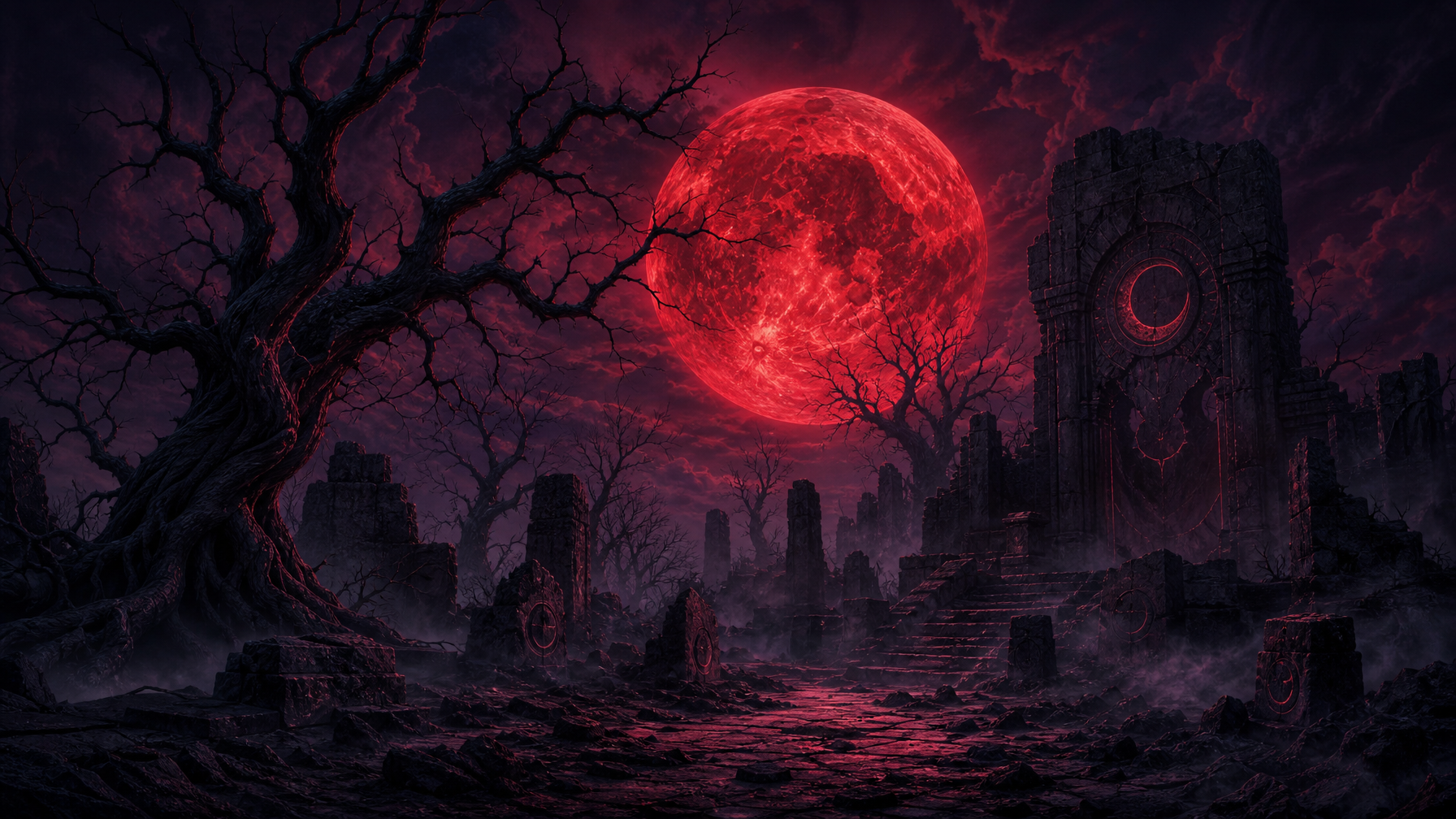
Across cultures, the blood moon — the full lunar eclipse that turns the moon a deep, arterial red — has been read as an omen. In Mesopotamian astrology, it predicted the death of kings. In early Christian eschatology, it signaled the end of days. In Norse cosmology, the wolves Sköll and Hati were said to finally catch the sun and moon at the end of the world.
Dark fantasy has inherited all of this.
The blood moon as a plot device works because it combines inevitability with spectacle. It is not a sudden catastrophe — it is a scheduled catastrophe. Characters know it is coming. They have time to fear it, prepare for it, argue about what it means. The dread is built into the calendar.
The most effective blood moon narratives use this foreknowledge as a source of character-driven tension rather than pure plot urgency. What do people do when they know the end is fixed on the horizon? Some fight. Some bargain. Some choose to believe the omens are wrong. And some — the most interesting ones — realize the blood moon isn't the catastrophe. It's the revelation of a catastrophe that was always already in motion.
Moon-Bound Creatures: The Mythology of Lunar Servitude
If the moon is powerful, it follows that something serves it — or is bound to it.
The concept of moon-bound creatures appears across global mythology in various forms. Werewolves are the most familiar Western example: beings whose transformation is involuntary, tied to the lunar cycle, and experienced as both gift and curse. But the tradition runs deeper and stranger than lycanthropy.
In certain West African traditions, specific spirits were believed to move between the human world and the spirit realm according to lunar phases. In Japanese folklore, moon rabbits were celestial servants of the lunar deity. Various Indigenous American traditions held the moon as a transformative power that altered the nature of both living and dead.
Dark fantasy takes this foundation and extends it into something more architecturally complex: creatures whose entire nature — their hierarchy, their power, their covenant obligations — is structured around the moon's cycle.
This is far more interesting than simple transformation. It means lunar creatures aren't just changed by the moon. They are defined by it. Their society, their politics, their sense of self — all of it organized around the celestial calendar in ways that feel ancient and inevitable rather than arbitrary.
The Moon's Curse Trilogy: A Case Study in Lunar Architecture
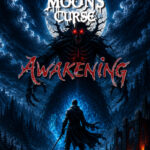
The Moon's Curse trilogy by Jason Moore — published through Londyn Publishing — represents one of the more thoughtful recent attempts to build a complete cosmological system around lunar mythology.
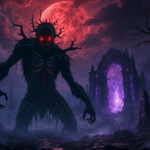
The Nythrall, the series' central creatures, are not vampires. This distinction matters. They are moon-bound entities — shadow-creatures whose power, hierarchy, and covenant obligations all revolve around the lunar cycle. Their connection to the Blood Moon is not metaphorical. It is contractual.
The Veil Covenant, which structures the relationship between the Nythrall and the human world, was written into existence by architects whose identities remain unknown even to the Nythrall themselves. It operates through sigils — twelve of them, not all written at the same time, the last four added after the first Covenant breach. Each sigil encodes a different obligation, a different allocation of power, a different clause that becomes operative under specific lunar conditions.
What the trilogy does well is treat all of this as history with consequences, not just worldbuilding texture. By the time the Blood Moon rises in the third volume, readers understand that they are not watching an apocalypse arrive. They are watching a scheduled reckoning — centuries of accumulated debts, deferred consequences, and unresolved clauses coming due simultaneously.
The characters — Evan Hartwell, Lira Thornfield, Auren Draevan, Father Kalen Draemir — each represent a different epistemological relationship to the Covenant. Evan confronts it as a soldier: the threat is real and must be fought. Lira approaches it as a scholar: understanding the mechanism is the only path to survival. Auren has lived adjacent to the Veil long enough to understand that some forces simply cannot be stopped, only witnessed with clear eyes. Father Kalen Draemir has studied the Covenant longer than anyone — and arrived at conclusions that make him the most dangerous figure in the series.
None of them are wrong about what the Blood Moon means. They simply disagree about what it requires.
This is mature lunar mythology: not power fantasy, not simple horror, but a reckoning with forces that are older than any individual story and indifferent to human urgency.
What to Look for in Lunar Dark Fantasy
If you're building your dark fantasy reading list around moon mythology, here are the markers of a series doing it well:
The moon has rules. Genuine lunar mythology in fiction establishes constraints and obligations, not just aesthetics. Power tied to the moon should have limits and conditions.
The cycle matters narratively. The best lunar fantasy uses the waxing and waning of the moon as a genuine structural element — not just a backdrop, but a ticking clock built into the world itself.
Creatures are defined by lunar covenant, not just lunar power. The most interesting moon-bound creatures in dark fantasy aren't just stronger under the full moon. Their entire social and political existence is organized around the lunar calendar.
The blood moon is earned. When a series builds toward a blood moon climax, the dread should be proportional to the preparation. Readers should feel the weight of every phase leading to it.
The mythology predates the story. The best lunar dark fantasy makes clear that the rules were established long before the narrative begins — that characters are not inventing the world, but discovering it.
Beyond the Veil
The moon in dark fantasy is not a light source. It is a ledger.
It records debts. It marks deadlines. It illuminates things that prefer the dark not to expose them, but because it has the right to — because something ancient, somewhere, negotiated that right and signed it into existence with marks no one living fully understands.
The genre is at its strongest when it honors that weight. When the blood moon rising isn't a special effect but a consequence. When the creatures it empowers are not monsters but signatories. When the characters caught beneath it are not heroes fighting evil, but people trying to survive a reckoning that was always coming.
The Moon's Curse trilogy — Awakening, Descent, and Blood Moon — is available now at londynpublishing.com. All three books are complete and in print. The reckoning has been written. What remains is the reading.