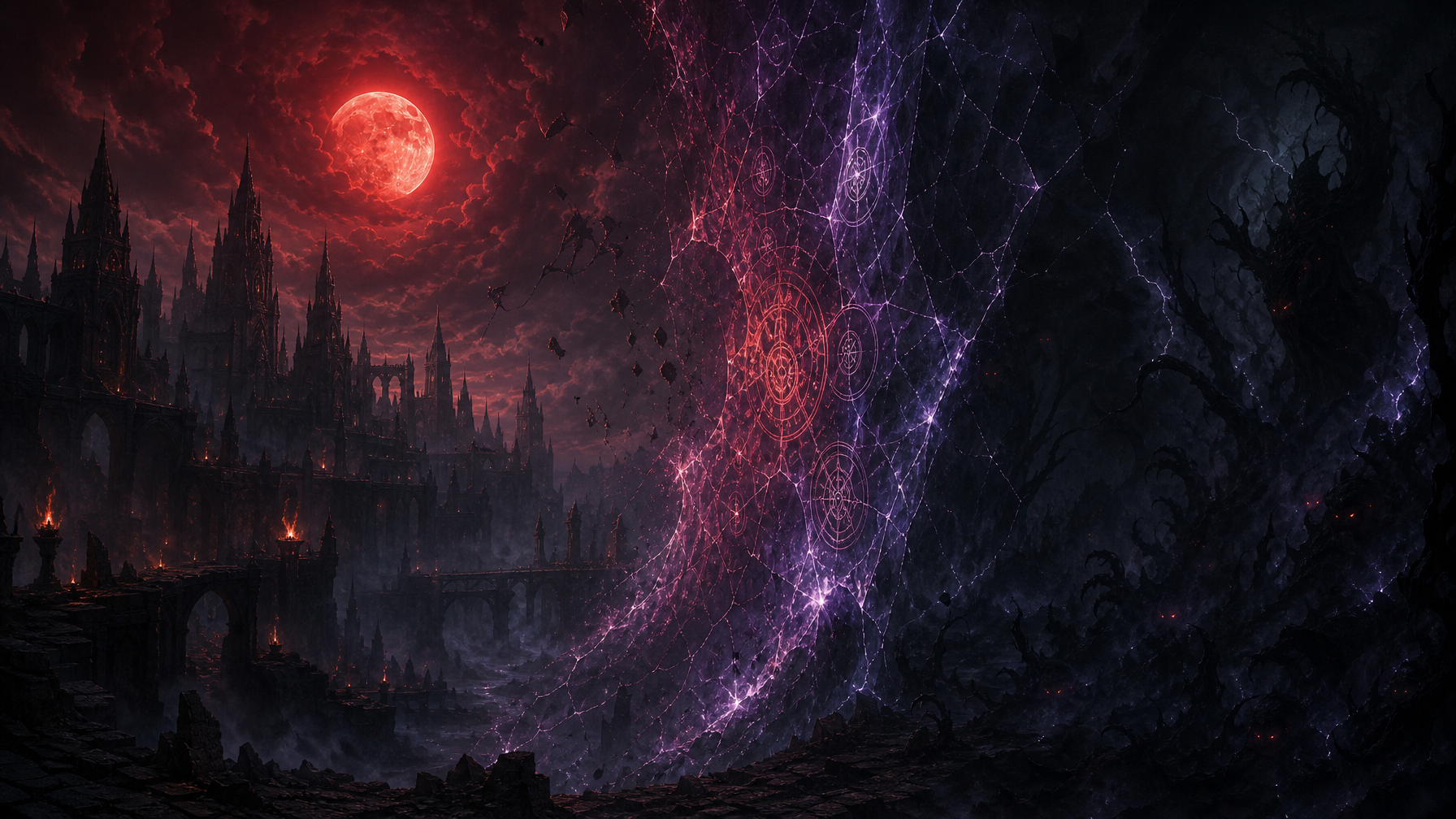

What Is the Veil? The Ancient Barrier at the Heart of The Moon's Curse Trilogy
There is no single concept more central to The Moon's Curse Trilogy than the Veil.
Not the Nythrall. Not the Blood Moon. Not even Evan Hartwell's fate.
The Veil comes first — and everything else is a consequence of what it is, what it was built to do, and what happens when it begins to fail.
If you have read Awakening, you have already felt the Veil without necessarily being able to name what you were feeling. It is the low hum of dread beneath ordinary scenes. The reason a shadow lingers a moment too long. The sense that the world you are standing in is thinner than it appears — that something is pressing against the other side.
This post is a lore deep-dive for readers who want to understand it fully.
A Barrier Between Worlds — But Not a Wall
Most dimensional barriers in fantasy fiction are walls. They are fixed, architectural, passive. The Veil in The Moon's Curse is none of these things.
The Veil is a living contract.
It was not constructed so much as agreed upon — a covenant between the architects of the old world and the entities that existed before human civilization had language for them. The Nythrall were not imprisoned by it. They signed it. The distinction matters enormously to the shape of the story, because it means the Veil can be honored, violated, renegotiated, or allowed to expire.
And it is expiring.
The Blood Moon is not a supernatural event that weakens the Veil from outside. It is the scheduled moment when the Veil's terms come due — a contract reaching its final clause. Every Blood Moon is a reckoning written into the original agreement. The question the trilogy asks is whether the world has kept its end of the bargain.
It has not.
What the Veil Actually Separates
Beyond the Veil lies what is most accurately described as the space between — not another world in the traditional fantasy sense, but a dimensional layer that predates the construction of the known world. The Nythrall did not originate there; they retreated there when the Covenant was signed. They have been maintaining the boundary from their side ever since.
This is one of the most misunderstood details about the Nythrall in early readings of Awakening. Readers often assume the Veil keeps the Nythrall out. It is more accurate to say the Veil keeps the two sides in agreement. The Nythrall are not predators stalking a cage door. They are signatories watching a deadline.
What passes through the Veil, and what does not, is governed by the twelve sigils written into the original Covenant. Each sigil controls a category of passage — not all of them are about creatures. Some govern knowledge. Some govern memory. Some govern the price of returning once you have crossed.
The Geography of Fracture
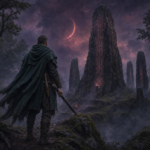
The Veil does not thin uniformly across the world. It fractures at nodes — specific geographic locations where the Covenant's architecture is oldest, or most stressed. Auren Draevan's role in The Moon's Curse is inseparable from these nodes. His forest-range territory is not incidental. He has been, for years before Evan Hartwell's story begins, a custodian of ground that sits directly against one of the Veil's weakest points.
This is why Auren reads as someone who knows something he will not say. He does. He has watched the light change in that forest for longer than anyone around him understands. What he has seen is not creatures trying to break through — it is the barrier itself becoming uncertain.
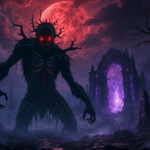
When the Veil thins at a node, the effect is not dramatic. It is the opposite. Silence where there should be sound. Familiarity that bleeds into wrongness. A tree that stands where it has always stood but casts a shadow in the wrong direction.
What the Collapse Means for the Characters
For Evan Hartwell, the Veil's collapse is personal before it is cosmological. He is pulled into the larger story through a specific and intimate breach — not a battle, not a prophecy handed to him, but an event that removes the distance between his ordinary life and the ancient mechanism coming undone around it.
For Lira Thornfield, the Veil's collapse is a scholarly crisis with catastrophic stakes. She has spent years mapping Covenant references, cross-referencing the sigil language, building a picture of what the original architects intended. What she discovers is that the architects anticipated the failure. They planned for it. They left instructions that no one has been able to read — because the final four sigils of the Covenant were written in a language predating the Veil's construction.
For Father Kalen Draemir, the Veil's collapse is theology. He does not fear it. He has studied the Covenant long enough to believe that what comes after the failure is not destruction — it is correction. He is wrong, but he is wrong in a way that is almost understandable.
Beyond the Veil
The title Beyond the Veil is not a location in the trilogy. It is a state — the condition of understanding what the world actually is, once the comfortable lie of the barrier is gone.
Every major character in The Moon's Curse ends the trilogy knowing something they cannot unknow. The Veil, even as it fails, does its final work. It changes what seeing means.
That is what the Veil was always built to do.
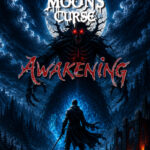
The Moon's Curse Trilogy — Awakening, Descent, and Blood Moon — is available now. All three books are complete and waiting. Begin at londynpublishing.com.