
Three thousand years is a long time to forget.
In the world of The Moon's Curse Trilogy, that is precisely the interval between one Blood Moon and the next — three millennia during which humanity rebuilds, expands, and, most fatally, begins to doubt what it once knew. The Veil holds. The Nythrall wait. And the people who live in the shadow of that boundary convince themselves, slowly and collectively, that the stories their ancestors told were exaggerations.
This cycle of civilizational amnesia is not backstory. It is the engine of the entire trilogy.
The Architecture of Forgetting
When the Blood Moon rises in Awakening, the world is not ignorant of the Veil. It simply no longer takes it seriously. Communities built at the Veil's edge have softened their rituals into folklore. Scholars who once catalogued the boundary's behavior have been replaced by scholars who catalog those scholars' work — two removes from the source, three from the truth.
What makes this so quietly devastating is that the forgetting is never intentional. No one chooses to abandon the knowledge. It erodes. A generation passes that did not experience the last Blood Moon directly. Then another. By the time Evan Hartwell and his companions are navigating a world coming apart at its seams, the institutional memory has been hollowed out so completely that the most dangerous thing in the world feels, to most people, like myth.
Three thousand years is long enough to build empires. It is long enough to dismantle the warnings that kept those empires standing.
Four Characters, Four Relationships to History
One of the most deliberate structural choices in the trilogy is how each of the four central perspectives relates to this collective amnesia differently — not as a thematic flourish, but as something embedded in who they are.
Evan Hartwell operates from instinct rather than record. As a warrior shaped by immediate threat and direct experience, Evan does not consult the archive. He responds to what is in front of him. This makes him effective in a crisis and blind to the longer pattern. He is, in many ways, the product of a civilization that has already forgotten — capable, trained, and entirely unprepared for the depth of what the Blood Moon actually represents.
Lira Thornfield knows the records exist. A scholar with fiery red hair and sharp teal eyes that miss nothing, Lira is one of the few people in the world actively trying to read across the gap. But knowledge that survives across three thousand years arrives fragmented. Lira's role in the trilogy is not simply to be the one who knows — it is to be the one who understands that what survived is incomplete by design, and that the incompleteness itself is the message.
Auren Draevan inhabits a third relationship to the past. As a ranger who moves through the wilderness at the Veil's margin, Auren has absorbed knowledge that never made it into formal records — the behavioral patterns of the boundary, the geography of its weakness, the way certain clearings hold differently at dusk. This is living memory, passed through practice rather than text. It is the most accurate knowledge in the world, and the least respected.
Father Kalen Draemir represents the most dangerous form of the forgetting: remembering selectively. He has access to the same institutional records as Lira, reads the same ancient texts, and arrives at conclusions that serve a theology rather than a truth. The archive, in his hands, becomes a tool for justification rather than understanding. He is not ignorant. He is worse than ignorant.
What the Veil Records
There is a reason the Veil itself functions as a kind of record-keeper in the trilogy's mythology. The boundary between the human world and the Nythrall is not passive. It carries the weight of every covenant signed across every Blood Moon cycle — every concession, every negotiation, every clause added under duress. Lira's discovery of the archive within the Veil's interior is not simply a plot point. It is the trilogy's central argument: that civilization's survival has always depended on someone being willing to read what the world would prefer to forget.
The moon-bound Nythrall do not forget. Three thousand years means something different to a creature whose existence is measured in cycles rather than lifespans. Every Blood Moon is not a crisis for them. It is a scheduled reckoning — one they have been preparing for since the moment the last one ended.
The asymmetry is the point. Humanity forgets. The Nythrall do not. And the gap between those two realities is where the entire trilogy lives.
Why This Story Works Now
Dark fantasy as a genre has always understood that the greatest threats are not the ones arriving from outside — they are the ones that civilization manufactures through its own confidence. The Moon's Curse Trilogy locates that truth at civilizational scale. The Blood Moon does not catch the world off guard because the Nythrall are clever. It catches the world off guard because three thousand years of peace is exactly long enough for a species to convince itself that peace is the natural state.
The books never treat this as a failure unique to one generation or one leader. It is the structural condition of human civilization in the trilogy's world. Which means the solution cannot be a single hero. It has to be something harder: a reckoning that forces an entire world to remember what it chose to stop believing.
That reckoning begins in Awakening. It deepens in Descent. By Blood Moon, the question is no longer whether civilization will survive the Nythrall — it is whether it deserves to.
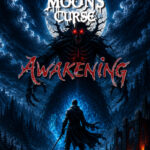
The Moon's Curse Trilogy — Awakening, Descent, and Blood Moon — is available now at londynpublishing.com. All three books are complete and in print.