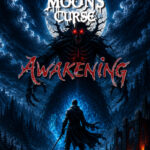


Writing a dark fantasy trilogy is one thing. Revising it. Three books, more than 300,000 words, a mythology built across thousands of decisions. Is something else entirely.
The Moon's Curse trilogy was written before any of it was published. That choice defined everything, including the revision process. When you know where the story ends before the first reader ever opens page one, you edit differently. You hold the entire structure in your head at once. You know which threads are load-bearing and which ones are ornamental. You know which scenes you love and which ones you have to cut.
This is the part of indie publishing no one talks about enough: the revision is where the book actually becomes itself.
The First Problem: Knowing Too Much
When I finished the first draft of The Moon's Curse: Awakening, I knew things Evan Hartwell didn't. I knew how the Veil worked. Not the surface-level dread a reader experiences in those early chapters, but the full architecture of the Veil Covenant, the seven nodes, the covenantal language written into basalt stone. I knew what the Nythrall had agreed to and what they had given up.
That knowledge is a liability in revision.
The temptation is to over-explain. To let a character articulate something that should remain unsaid, to have the world announce its own rules because you, the author, are confident in them. Dark fantasy readers don't want that. They want the texture of a world that is older and stranger than any single character's understanding of it. They want to feel that there is more beyond the edge of the page.
So a significant portion of my revision work on Awakening involved removing clarity. Pulling back exposition. Letting Evan Hartwell be genuinely confused. Not as a reader surrogate, but as someone whose instincts outpace his knowledge, who acts on incomplete information because that is the only information available to him. The atmospheric density of that book is not accidental. Most of it was built in the edit.
Cutting What You Love
Every writer has heard the advice: kill your darlings. It sounds clean in theory. In practice, it means sitting with a scene you spent two weeks writing. A scene you like, a scene that works on its own terms. And accepting that it belongs to a different draft of this book, not the one you are building now.
I cut a chapter from Descent that I still think about. It was a conversation between Lira Thornfield and a scholar she meets while researching the Covenant archive, a figure who knew more than he admitted. The scene had atmosphere. It had subtext. Lira's voice in it felt exactly right. Her particular combination of precision and urgency, the way she approaches incomplete records not as gaps but as messages.
The scene came out because it delayed a structural turn that the book needed to make by chapter twelve. No amount of atmosphere justifies that kind of pacing cost. Lira's voice found other places to live. The scholar never appeared again.
That is how revision works in long-form dark fantasy. You are not making individual scenes better in isolation. You are calibrating the entire system.
Lore Consistency Across 300,000 Words
The Moon's Curse mythology is precise. The rules of the Veil, the terms of the Nythrall Covenant, the properties of the Blood Moon. These are not vague. They have internal logic, and that logic has to be consistent across three books written over a significant stretch of time.
The revision pass I called the "lore audit" was the most methodical work of the entire project. It meant going through every reference to the Veil's behavior, every mention of the seven nodes, every moment where a character draws a conclusion about the Nythrall's intentions, and confirming that each of those moments was accurate to the world's rules as established by the time Blood Moon reaches its ending.
Auren Draevan's knowledge of the Veil's geography, for instance, had to be calibrated carefully. He knows things about the land around the Veil's edge that other characters don't. Things passed down through the communities that built their lives along that boundary. What he knows in Awakening cannot contradict what becomes explicit in Blood Moon. It can foreshadow it. It can point toward it obliquely. But it cannot break the internal logic of the world.
Father Kalen Draemir presented a different challenge. His understanding of the Covenant is selective and self-serving, which is accurate to his character. But the reader should be able to recognize, on a second read, exactly which elements of the Covenant theology he is misrepresenting and why. That requires precision in the editing room, not just in the writing.
What the Process Taught Me
Editing a trilogy as an indie author, without the structural apparatus of a traditional publishing house, means the quality control is yours. No editorial letter. No developmental editor pushing you to interrogate your structure. Just the manuscript and your own critical distance, which takes time to build.
The most practical thing I learned: do not revise immediately after drafting. Let a book rest long enough that you can read it as a reader, not as the person who wrote it. That distance is where honest revision becomes possible. It is also where you stop defending scenes and start evaluating them.
The Moon's Curse trilogy is the story I wanted to tell. The revision process is how I made sure it was actually telling it. Scene by scene, chapter by chapter, all the way beyond the Veil.
The Moon's Curse trilogy. Awakening, Descent, and Blood Moon. Is available now at londynpublishing.com. All three books are complete. No waiting.