Archived Record
Codex Fragmenta Bestiarum
KOH-deks frag-MEN-tuh bes-tee-AIR-um
The Fragmented Bestiary Codex
Public Record
Teaser
An ancient archive shattered across the realms, its surviving fragments preserve knowledge of creatures, bindings, fractures, and secrets that were never meant to be reunited.
Excerpt
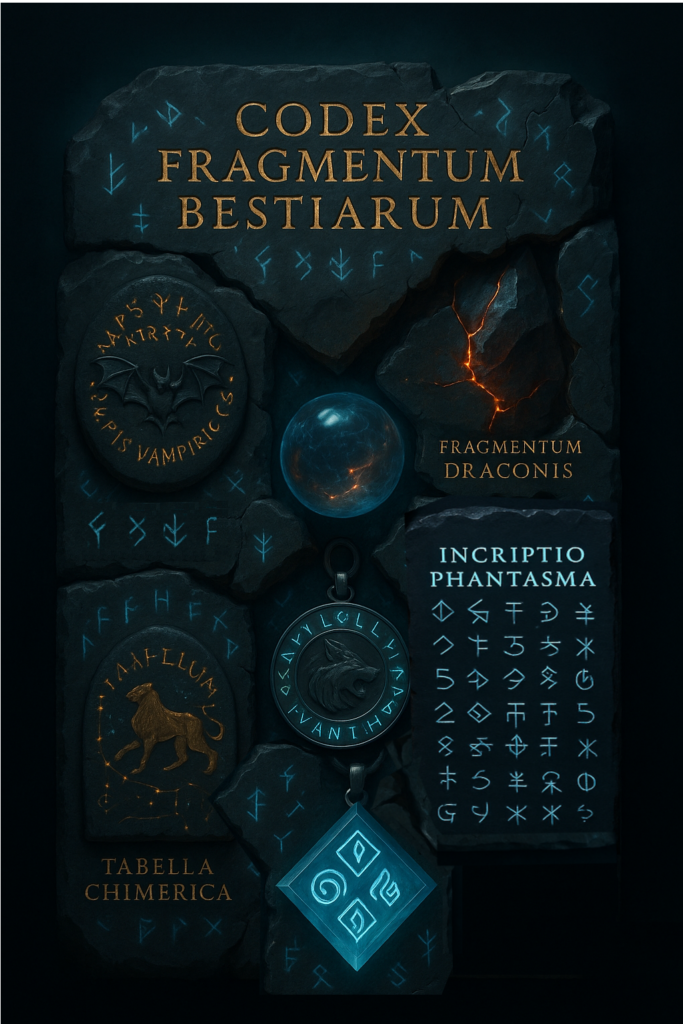
A fragment of the Codex Fragmenta Bestiarum. A piece of the ancient knowledge that once bound the creatures of the Void and the material realms.
Summary
The Codex Fragmenta Bestiarum is one of the oldest and most mysterious artifacts associated with the Veil.
Often mistaken for a simple bestiary, the Codex preserves far more than accounts of supernatural creatures. Its scattered fragments contain traces of ancient knowledge concerning entities, bindings, protective rites, fractures, and the forces that exist beyond the boundaries of the mortal realms.
The complete Codex no longer survives as a single accessible archive. Its fragments have been scattered, hidden, guarded, lost, and rediscovered across generations. Some appear to contain records of creatures. Others preserve symbols, rituals, warnings, or pieces of knowledge whose significance becomes apparent only when compared with other fragments.
Even individually, the surviving pieces are dangerous artifacts.
Together, they may represent something far greater.
Whether the Codex was broken apart merely to preserve its knowledge—or to prevent that knowledge from ever being reunited—remains one of the most closely guarded questions in the archive.
Known As
The Fragmented Bestiary Codex; The Bestiary Codex; The Fragmented Codex; The Codex
Origin Hint
Its fragments remember a time when the Veil's oldest guardians knew how to bind what waited beyond it.
Region Blurb
No single region can claim the Codex. Its fragments have passed through forgotten sanctuaries, sealed archives, dangerous ruins, and places touched by instability in the Veil. Wherever a fragment is recovered, its presence usually points toward a much older history.
Some knowledge was scattered because it was too dangerous to destroy.
Related Entries
Tabella Chimerica
Fragmentum Draconis
Inscriptio Phantasma
Lapis Vampiricus
Sigillum Lycanthropi
Lamina Elementalis
Tabula Lupina
Lunar Tablet
Amulet of Vitae
Seal of Eternal Death
Sigillum Nocturnum
Prooemium Arcanum
Blood Moon Fragment
Veil Guardian
The Keeper
The Veil
Vale of Darros
The First Fracture
Kaelen Virelith
Archivist Thalen
Enter the Restricted Archive
The public record contains only fragments. Veil members with sufficient clearance may access recovered history, artifact analysis, Guardian records, and restricted findings concerning the Codex Fragmenta Bestiarum.
Join the VeilCodex Intelligence
Artifact Profile
- Artifact Type
- book
- Status
- damaged
- Origin
- The Codex Fragmenta Bestiarum was created by the ancient Veil Guardians as a unified repository of knowledge concerning the Veil, the entities that existed beyond or threatened its boundaries, and the rituals required to contain forces capable of crossing between realms. More than a simple bestiary, the Codex preserved generations of accumulated observations, classifications, binding methods, protective rites, accounts of fractures, and knowledge concerning the supernatural mechanisms that sustained the Veil. Its creators intended the work to serve both as a record of what they had encountered and as a practical instrument for those charged with preserving the boundary.Originally, the Codex existed as a single, unified text. Its individual sections were designed to complement one another, connecting knowledge of creatures and their weaknesses with the rituals, sigils, bindings, and principles necessary to confront them. A description of an entity in one portion might correspond to a containment method preserved elsewhere, while records concerning fractures could provide the knowledge necessary to determine which ritual or protective measure was required. The true strength of the Codex therefore came not merely from the information contained on individual pages, but from the relationships between its records.Following the fall of the Veil Guardians, the unified Codex presented a profound danger. In the wrong hands, the same knowledge capable of sealing breaches and imprisoning supernatural entities could potentially be used to weaken protections, manipulate bindings, or free forces that had deliberately been confined. To prevent this, the surviving Codex was divided into fragments. By separating its knowledge, no single individual could easily possess the complete understanding necessary to wield everything the Guardians had preserved.The fragments were subsequently scattered and concealed in locations chosen specifically for their difficulty of access. Some were entrusted to guardians or hidden behind ancient protections, while others were placed in regions where the landscape, supernatural conditions, or dangers surrounding them served as defenses of their own. Their locations gradually disappeared from reliable historical record. As generations passed, knowledge of the Codex became increasingly fragmented as well, surviving through incomplete references, monastery records, forgotten texts, oral traditions, and stories whose distinction between history and legend became increasingly difficult to determine.Despite their separation, individual fragments retain significant value. Each preserves a portion of the original Codex's knowledge and may contain information concerning particular creatures, supernatural phenomena, fractures, bindings, or rituals. A fragment may provide the key to understanding a specific threat while revealing almost nothing about another. This incompleteness makes possession of a fragment both valuable and dangerous: the knowledge it contains may be genuine, yet the missing portions of the Codex can deprive its reader of the context necessary to understand the full consequences of using it.Reassembling the Codex is therefore considered a nearly impossible undertaking, but one of enormous importance. United, its fragments would restore connections between records that have remained separated for generations. Creature classifications could once again be examined alongside their corresponding weaknesses and containment methods; accounts of fractures could be compared against the rituals intended to stabilize them; and seemingly unrelated pieces of Veil lore could reveal their place within a much larger system. The reunited Codex would also possess a strategic value greater than the sum of its individual fragments. Knowledge distributed across separate records could be applied together, potentially allowing more sophisticated rituals, coordinated countermeasures against multiple supernatural threats, and a deeper understanding of the mechanisms governing the Veil itself. Rituals preserved only partially within one fragment might become complete when interpreted alongside another, while apparently isolated symbols, instructions, or warnings could acquire entirely different meanings once their missing context was restored.For those opposing Vorath and the forces threatening the Veil, this makes the Codex more than an ancient historical artifact. Reassembling it represents a path toward recovering knowledge deliberately scattered after the Guardians' fall—knowledge that may be necessary to understand the expanding fractures, confront the creatures emerging through them, strengthen or restore failing protections, and determine how the Veil can survive the conflict to come.Yet the reason the Guardians divided the Codex remains inseparable from the reason others seek to restore it: unified knowledge is power. Reassembling the Codex may provide the means to preserve the Veil, but it would also recreate the very concentration of knowledge the Guardians once considered too dangerous to leave intact.
- Known Wielders
- The Keeper, Veil Guardian
- Materials / Composition
- The Codex Fragmenta Bestiarum is not a conventional bound book, but a collection of individually inscribed dark stone tablets, carved plaques, seals, medallions, crystalline components, and rune-bearing fragments that together form the greater Codex. The surviving pieces vary in shape, size, and composition, reflecting the different creatures, forces, and knowledge preserved within them. The primary tablets are formed from dense, dark mineral or stone-like material engraved with runes, sigils, diagrams, and inscriptions. Some markings appear as metallic gold or bronze inlays, while others emit a distinct blue-cyan luminescence associated with their supernatural properties. Certain fragments incorporate specialized materials or embedded components appropriate to the knowledge they contain, including carved creature emblems, metallic seals, translucent or crystalline structures, and Veil-responsive objects. Rather than pages arranged sequentially within a volume, the Codex's components function as pieces of a larger physical and arcane archive. Individual fragments—including the Fragmentum Draconis, Inscriptio Phantasma, Tabella Chimerica, and other surviving components—preserve separate portions of the original body of knowledge. Their inscriptions, symbols, and embedded materials serve not merely as decoration but as part of the Codex's supernatural architecture. When separated, each component remains a distinct artifact capable of preserving its assigned knowledge and properties. When brought together, the fragments form an interconnected system, allowing their inscriptions, seals, and supernatural resonances to interact. The Codex is therefore best understood as a fragmented lithic and arcane construct rather than a traditional manuscript—its knowledge physically encoded into stone, metal, crystal, sigils, and Veil-responsive materials designed to survive long after ordinary parchment or bindings would have decayed.
- Limitations / Weaknesses
- The Codex is incomplete while its fragments remain separated, preventing access to its full body of knowledge. Individual fragments contain only portions of the original record and may lack context necessary to safely perform the rituals they describe. Damage, missing pages, corruption, or incorrect interpretation can further compromise their usefulness.
- Cost / Consequences
- Knowledge contained within the Codex can be dangerous when used without sufficient understanding. Binding and sealing rituals may demand significant preparation, supernatural energy, sacrifice, or exposure to the entities and forces being contained. Improper use risks worsening the very instability the Codex is intended to counter.
- Associated Rituals
- Ritual of Binding, Containment Incantation, First Sealing, Blood Rite at the Threshold, Codex Revelation Rite, Severing Rite, Nexus Stabilization
- Artifact Notes
The Codex Fragmenta Bestiarum is an ancient body of fragmented knowledge concerning supernatural creatures, binding practices, Rift phenomena, and the forces beyond the Veil. In The First Fracture, a surviving fragment is used during an attempt to seal a Rift, while the Keeper describes the Codex as both a seal and a key—knowledge capable of binding and imprisoning that which should not be free.
Veil Profile
- Veil Alignment
- Veil-Aligned
- Veil Status
- Stable
- Veil Proximity
- Resonant
- Veil Alignment Notes
The Codex is closely associated with the protection, study, and stabilization of the Veil. Its fragmented condition reflects the loss of unified knowledge rather than corruption, and its surviving contents remain primarily concerned with containment, binding, and understanding supernatural threats.
- Aliases
- The Fragmented Bestiary Codex | The Bestiary Codex | The Fragmented Codex | The Codex
- First Appearance
- The First Fracture
- Last Appearance
- The Moon's Curse: Blood Moon
- Book Appearances
- The First Fracture, Awakening, Descent, Blood Moon
Visual Archive
Codex Gallery
Map & Timeline
Geographic position, chronology and interactive world intelligence will appear here.