
In a trilogy defined by collapsing boundaries and rising darkness, it would be easy to overlook the figure standing at the perimeter. While Evan Hartwell charges toward the Veil and Lira Thornfield deciphers what the Veil means, there is one character who has always known what lives on the other side — and has been watching it, silently, long before the story begins.
That figure is Auren Draevan.
The Ranger at the Edge of Everything
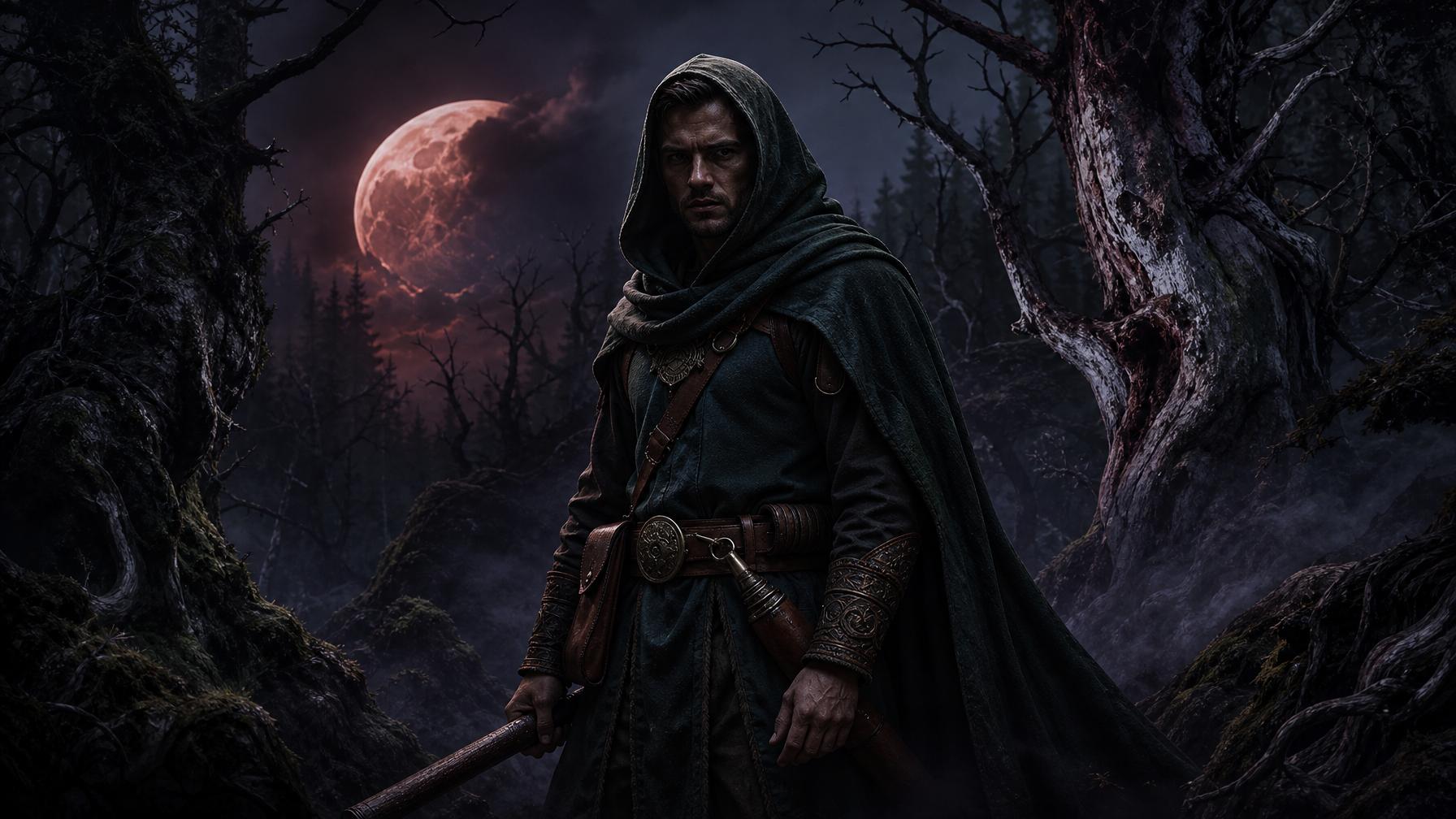
Auren is introduced in The Moon's Curse: Awakening as a ranger operating in the contested wilderness that borders the Veil's outer threshold — a geography that most characters treat as forbidden, and most readers come to understand as deeply wrong. The trees here grow at angles that defy gravity. Sound carries too far and then, without warning, not at all. Auren has made this territory his home.
He wears a forest green cloak that reads, at first glance, as practical. But in the world of the Moon's Curse, colors carry weight. Green belongs to the living world — to root systems, to old growth, to the things that predate the Veil's construction. That Auren has claimed it as his signature says something deliberate: he is a creature of the threshold, allied neither to the structured human world nor to the consuming darkness beyond it. He belongs to the in-between.
This is not a comfortable place to inhabit. And Auren, to his credit, has never pretended otherwise.
A Warrior Shaped by Witness
What distinguishes Auren from other warriors in the series is that his fighting style emerged not from training halls or formal orders, but from years of watching the Nythrall move. He has studied them the way scholars study texts — cataloguing their patterns, their preferences, their hierarchies. Where other characters react to the Nythrall with horror or awe, Auren responds with something closer to grim familiarity.
The Nythrall, for those new to the series, are not traditional monsters. They are moon-bound shadow entities — creatures whose behavior, threat level, and physical form shift with the lunar cycle. During ordinary nights, they test boundaries. Beneath the Blood Moon, those boundaries dissolve entirely. Most people in the world of the trilogy know the Nythrall as legend, as warning, as myth.
Auren knows them as neighbors.
This makes him invaluable to Evan and Lira, but it also makes him difficult to fully trust. Characters in the series, and readers alongside them, are never entirely sure whether Auren's knowledge of the Nythrall is the result of heroic vigilance — or something more complicated. He carries that ambiguity deliberately, and the narrative respects it.
Loyalty Without Sentimentality
One of the most quietly powerful things about Auren Draevan is how he expresses loyalty. He does not declare allegiances. He does not make promises that echo through chapters. When Auren commits to protecting someone or pursuing a course of action, he simply does it — and the reader only realizes how deeply invested he is by watching what he refuses to walk away from.
This makes his relationship with Evan one of the more textured bonds in the trilogy. They are not mirror images. They do not balance each other in the tidy way of fantasy companions. Their dynamic is more friction-laden: Evan's instinct is to move toward the source of danger; Auren's instinct is to understand it first. The tension between those two approaches drives some of the most charged moments across Descent and Blood Moon.
Auren's relationship with Lira Thornfield is built on a different kind of respect — the recognition that her scholarly approach to the Veil yields answers that raw experience cannot. He has seen things she has only theorized. She has understood things he has only survived. Between them, they assemble a more complete picture of what the Veil actually is and what its collapse would mean.
What the Watch Costs
The series does not allow Auren's vigilance to be a costless virtue. The years he has spent at the threshold have marked him in ways that become more legible as the Blood Moon rises. He has watched people he cared about cross into the Veil's influence and not come back as themselves. He has made choices in those moments that he does not fully explain — and the series does not fully exonerate him for those choices, either.
This is what makes Auren feel real rather than archetypal. The ranger role in fantasy often defaults to the noble loner, the stoic guide, the figure who exists to move the protagonist forward. Auren does all of those things, but the narrative charges him with a psychology that complicates every function he fills.
He has been watching the darkness for so long that he has had to decide, over and over, what watching costs him — and whether the cost is worth paying.
Reading Auren in the Context of the Full Trilogy
For readers making their way through the complete series, Auren Draevan rewards close attention across all three books. Details dropped quietly in Awakening become structurally important by Blood Moon. His silences accumulate meaning. The things he does not say in early chapters answer questions the later story eventually asks out loud.
He is not the trilogy's most visible character. But he may be the one who understands its world most completely.
The Moon's Curse Trilogy — Awakening, Descent, and Blood Moon — is available now in paperback, hardcover, and eBook at londynpublishing.com. The complete series is waiting beyond the Veil.