
The Art of the Slow Reveal: How I Write Mystery Into The Moon's Curse
There is a particular kind of reader satisfaction that has nothing to do with answers.
It lives in the moment before the explanation — in the half-seen shape beyond the tree line, the sentence that ends just before the revelation, the character who knows something and chooses not to say it yet. Writing The Moon's Curse trilogy taught me that the most powerful tool a dark fantasy author has is not what they put on the page. It is what they leave off it.
This is the philosophy I call the slow reveal. And it is the single most deliberate craft decision I made across all three books.
The Question Behind Every Chapter
Before I write any scene in The Moon's Curse, I ask myself one question: What does the reader not know yet that they need to feel the weight of what's happening?
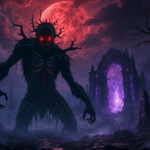
In Awakening, Evan Hartwell does not understand the Veil. He knows it exists — everyone does — but he has no framework for what it means that it is fracturing. That ignorance is intentional. His confusion is the reader's confusion, and his first encounter with the Nythrall carries weight precisely because neither he nor the reader has been told what a Nythrall truly is. The creature is described through sensation, not classification. Cold that moves. Eyes that do not blink because they do not need to.
I could have opened the trilogy with a lore dump — the history of the Veil Covenant, the twelve sigils, the ancient agreement that kept the moon-bound creatures beyond the threshold. I chose not to. The mythology is there from chapter one, but it is submerged. The reader feels its presence without yet having the language to name it.
That is the slow reveal at work.
Withholding as World-Building
One of the most counterintuitive lessons I learned writing this series: restraint builds a bigger world than exposition does.
Lira Thornfield is introduced as a scholar. She has studied the Veil Covenant for years. She knows things Evan does not. But rather than using Lira as a delivery mechanism for information, I gave her selective silence — moments where she understands exactly what she's seeing and says nothing, because saying it aloud would make it undeniably real.
That silence is more unsettling than any explanation I could have written. The reader learns, through Lira's restraint, that knowledge in this world is not power. It is weight. The more you understand about the Veil, the more you carry.
This is how world-building becomes atmosphere. The mythology of The Moon's Curse is never explained in full because it was never meant to be fully understood. The Nythrall do not have origin stories that resolve cleanly. The Blood Moon does not arrive on a schedule anyone predicted accurately. The sigils on the Veil Covenant predated the language used to translate them — and the archivists who attempted that translation did not all survive it.
These are not plot holes. They are intentional shadows. Dark fantasy breathes in the space between what is known and what is feared.
Structure That Earns the Revelation
The slow reveal only works if the payoff is real.
Nothing frustrated me more, as a reader before I was a writer, than mystery for mystery's sake — gaps in the narrative that turned out to have no real substance behind them. The slowness of the reveal has to be proportional to the weight of what is eventually revealed.
In Descent, the middle book of the trilogy, Auren Draevan's relationship with the Nythrall comes into sharper focus. By that point, the reader has spent an entire book sensing that Auren carries something the others do not. He moves differently near the treeline. He does not react to the creatures with the same visceral fear. When the explanation finally arrives, it does not feel like a twist. It feels like a truth the reader already suspected but could not yet name.
That recognition — I knew it, but I didn't know I knew it — is the emotional payoff of a well-constructed slow reveal. The satisfaction is collaborative. The reader did the work alongside me.
Writing Into the Dark
What this all means practically, for me, is that I write the explanations before I write the book — and then I remove them.
I know what the Veil Covenant actually is. I know the full history of the twelve sigils, which six have been translated, what happened to the scholars who attempted the remaining six. I know the exact mechanism behind the Blood Moon. All of that exists in my notes. None of it appears in the trilogy in a clean, instructional form.
Instead, fragments surface when a character would realistically encounter them. Evan glimpses a sigil and recognizes it without knowing why. Father Kalen Draemir references an agreement in a way that implies far more than he says. The Nythrall behave according to rules that the reader slowly deduces before any character names those rules aloud.
This is what I mean when I describe Beyond the Veil — not just as a metaphor for the series, but as a writing philosophy. The most meaningful parts of The Moon's Curse trilogy live beyond the edge of what is directly shown. The world is larger than the pages contain. And the reader's imagination, given just enough shape to work with, will always build something more powerful than any exposition I could have provided.
The slow reveal is not a technique for withholding information from the reader.
It is a technique for trusting them.
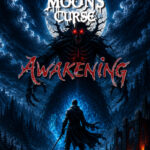
The Moon's Curse Trilogy — Awakening, Descent, and Blood Moon — is available now at londynpublishing.com. The complete series is finished and waiting.