

Mastering dark fantasy worldbuilding requires far more than mapping sprawling empires or inventing baroque pantheons. In truly atmospheric fantasy literature, worldbuilding functions as an active participant in the story, a creeping, physical force that imposes rules, extracts costs, and leaves irreversible scars on every soul attempting to cross its borders.
When readers open stories by authors like Andrzej Sapkowski, George R.R. Martin, or Christopher Buehlman, they are not searching for neat escapism. They are drawn to environments characterized by dread, moral ambiguity, and systems where power carries a devastating price. To create an immersive setting that lingers in the reader’s imagination, authors must ground their worlds in tangible friction rather than decorative spectacle.
1. Establish Natural Laws Governed by Friction and Debt
The defining line between standard high fantasy and dark fantasy lies in how magic and geography interact with humanity. Standard systems often treat magic as an unblemished resource or a skill to be mastered. In contrast, dark fantasy worldbuilding treats supernatural power as a volatile transaction, a legalistic pact or a decaying covenant where every privilege creates a corresponding deficit.
Consider how boundaries operate. In a typical adventure, a magic barrier is simply a wall to climb or shatter. In dark fantasy, a boundary should function like an ancient contractual debt. When a ward thins, it does not collapse cleanly; it rots, drawing nearby settlements into silence, warping the weather, and demanding living collateral before anyone is allowed safe passage.
As explored in our deep-dive into Lira Thornfield and the Cartography of the Veil, the physical geography itself refuses to remain static when an ancient barrier breaks down. Roads shift underfoot, landmarks migrate, and maps become obsolete before the ink has dried.
2. Ground the Atmospheric Dread in Specific Physical Details
Atmosphere is not created by lathering sentences in gothic adjectives. It is built through small, inescapable sensory realities that remind the reader of constant vulnerability:
- The Logistics of Survival: What does unholy weather smell like before a raid? Why do frontier settlements sweep ash from their thresholds at dawn? How do ordinary travelers recognize an expired safe passage?
- Institutional Complicity: In dark worlds, organized religions and civil authorities are rarely wholly righteous or villainously theatrical. Instead, they are bureaucratic, compromised, and weary. Orders log horrifying compromises as routine procedure just to keep the city gates shut against the dark.
- Remnants of the Past: Avoid generic ruins. Every broken archway, abandoned watchtower, or rusted boundary nail should signify a broken promise between mortals and whatever entities formerly ruled the soil.
Readers want to inhabit an environment that feels lived-in and scarred. When institutions treat cataclysm as mundane ledger work, the world gains weight and authenticity.
3. Replace Monolithic Monsters with Uncompromising Ecology
Monsters in dark fantasy literature should never serve as random combat encounters designed to test a protagonist’s battle prowess. They belong to an uncompromising supernatural ecology. Their motives must align with the metaphysical laws of the world rather than simple malice.
For instance, examine the distinction between conventional vampires and original predatory species in our analysis of moonbound creatures in dark fantasy beyond vampires. When creatures are bound to cosmic cycles, such as the lunar pull of a Blood Moon, their hunting behavior feels like an inevitable tide rather than a sudden ambush. They do not negotiate, because their survival is anchored to the very fabric of the cosmos.
4. The Inevitable Reckoning: Anchoring the Story to Consequences
Ultimately, compelling worldbuilding must serve character dilemmas. When characters are forced to navigate compromised landscapes, their moral choices become visceral. Evan Hartwell, Lira Thornfield, Auren Draevan, and Father Kalen Draemir are not merely combating monsters Beyond the Veil; they are paying the accumulated debts of a civilization that bargained away its tomorrow.
If you are an author or an avid reader seeking narratives where world architecture and narrative tension weave seamlessly together, study how complete series sustain their internal logic across multiple volumes. In our look at indie fantasy author craft and writing a complete series before launch, we break down why having the entire narrative arc planned preserves continuity and thematic resonance from page one to the final chapter.
Explore the Lore Beyond the Veil
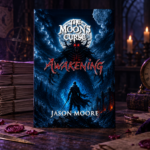
The Moon’s Curse Trilogy, spanning Awakening, Descent, and Blood Moon, immerses readers in a brutal, meticulously crafted universe where ancient covenants unravel beneath a crimson sky. Discover the full saga, explore character archives, and examine the complete collection of hardcovers, paperbacks, and digital editions at londynpublishing.com or explore the series directly in our books catalog.