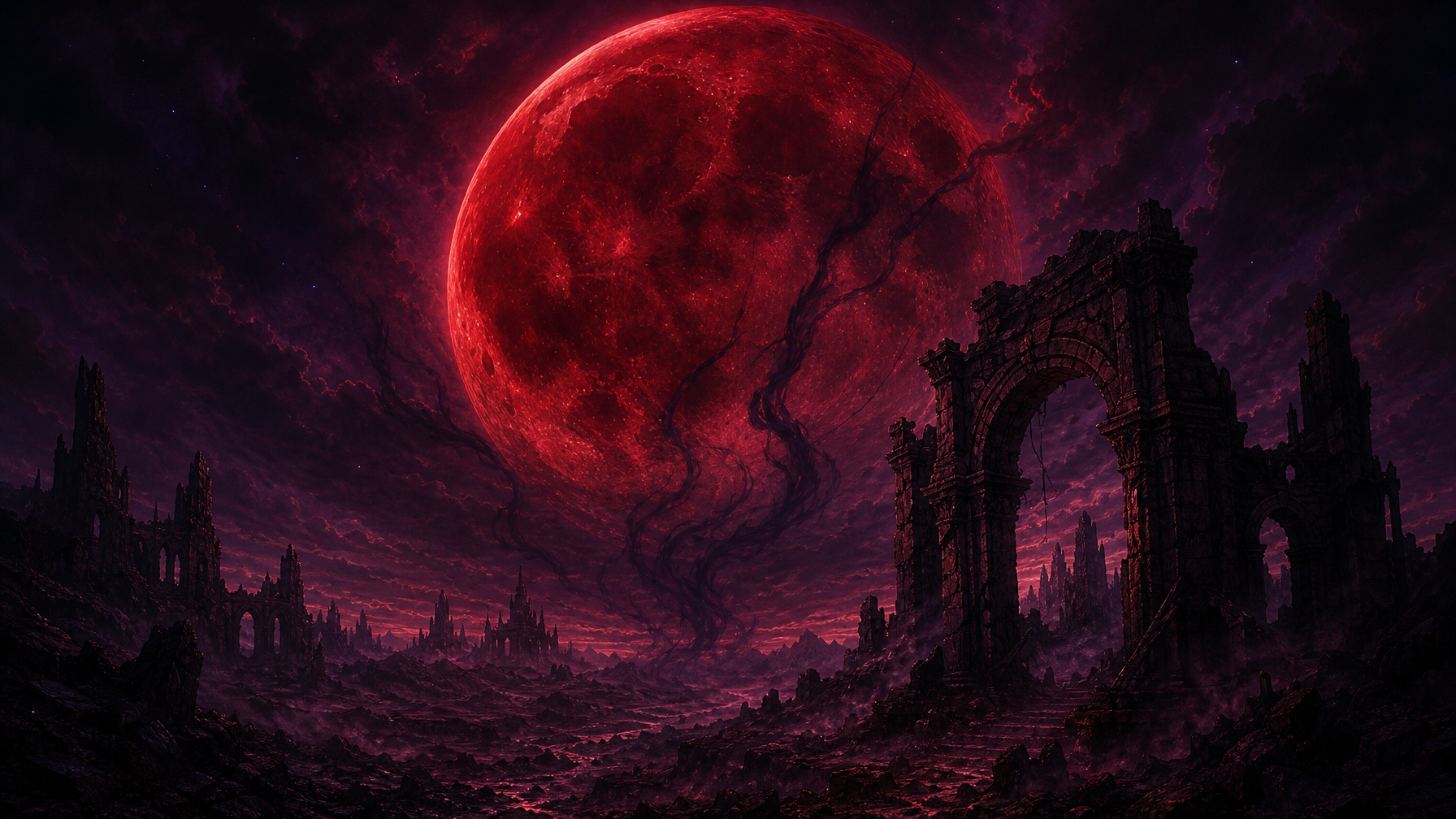

In most stories, a Blood Moon is a backdrop. A visual flourish. A way to signal that something dark is coming.
In The Moon's Curse Trilogy, the Blood Moon is the entire story.
It is not an omen. It is not a metaphor. It is the mechanism — an ancient, astronomical event hardwired into the very architecture of the world, capable of unraveling the one barrier standing between humanity and something far older than civilization itself. Understanding the Blood Moon is understanding everything: the Veil, the Nythrall, the Veil Covenant, and why Evan Hartwell and his companions were never truly fighting a war they could win. They were fighting a tide.
Not a Symbol. A System.
From the opening pages of Awakening, the Blood Moon functions less like a prophecy and more like a countdown. The Veil — the dimensional boundary that separates the human world from the domain of the Nythrall — is not static. It breathes. It weakens. And it weakens in cycles governed by the moon.
When the moon bleeds red, the Veil thins to near-transparency. The rules that govern what can and cannot cross that boundary loosen. Shadow deepens in ways that shadow should not. And the Nythrall, those moon-bound creatures of instinct, memory, and hunger, stir with something that is not quite intelligence but is unmistakably awareness.
This is not lore buried in a codex. It is the engine that drives every decision every character makes across all three books.
The Covenant Was Never a Solution
The Veil Covenant — the ancient pact upon which the world's fragile safety rests — was not designed to stop the Blood Moon. It was designed to outlast it. To hold the Veil rigid through each cycle, reinforced by sigils older than any surviving language, maintained by orders whose purpose had long since been forgotten by the general population.
The catastrophic truth revealed slowly across Awakening, Descent, and Blood Moon is that the Covenant was always degrading. The sigils were never meant to be permanent. The founders who inscribed them understood that each Blood Moon would cost something — a fraction of structural integrity, a hairline fracture in the dimensional fabric. What they apparently did not plan for, or what they chose not to record, was what would happen when the cost finally exceeded the remaining strength of the Veil.
Lira Thornfield comes closer than anyone to understanding this. Her scholarship is not merely academic — it is archaeological, forensic, desperate. She reads the original Covenant texts and finds something the archivists who disappeared before her clearly also found: the Blood Moon was not a threat the Covenant was designed to eliminate. It was a debt the Covenant was designed to defer.
The bill, by the time of Awakening, was overdue.
What the Nythrall Know
The Nythrall are not simply dangerous because they are powerful. They are dangerous because they are patient.
Moon-bound in the truest sense, they have oriented their entire existence around the cycles the Covenant was built to suppress. While human generations lived and died in relative peace, the Nythrall waited. They learned. And the Blood Moon, to them, is not a catastrophe — it is a homecoming.
This inverts the emotional logic of most dark fantasy. The horror in The Moon's Curse is not that something evil is attacking. It is that something ancient is returning — and that the world humanity built in its absence was always, from that perspective, temporary.
Why Evan Hartwell Matters
Evan Hartwell does not arrive on the scene with the tools to stop the Blood Moon. No one has those tools. What he has is something rarer in the world the trilogy depicts: the willingness to act in full knowledge that the outcome may not be victory in any traditional sense.
The Blood Moon rising over the final arc of Blood Moon is not a failure of the protagonists. It is the culmination of a thousand-year structural collapse that pre-dates every character in the story by centuries. What Evan, Lira, and Auren Draevan are fighting for is not reversal. It is meaning. It is the question of what it is worth to stand at the edge of something inevitable and refuse to step aside.
That is the real subject of The Moon's Curse Trilogy.
The Blood Moon rises. It was always going to rise. The story is about who you become in the time you had before it did.
The Moon's Curse Trilogy — Awakening, Descent, and Blood Moon — is complete and available now at londynpublishing.com. Enter the Veil.