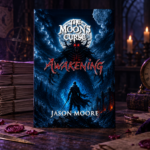

Every author has a revision habit they hide from their critique partners. At Londyn Publishing, my quiet obsession is what I call the continuity desk pass. Before The Moon’s Curse Trilogy ever reached a reader, I refused to evaluate Awakening, Descent, and Blood Moon as three distinct projects. When you write a complete series before shipping book one, revision is not line editing. It is a full accounting audit of cause, consequence, and physical geography across twelve hundred manuscript pages.
Most serialized fiction is drafted under the shadow of rapid release: finish volume one, ship it, and pray you did not leave a logistical contradiction in chapter four that breaks the magic system eighteen months later. Because our entire series was written as a unified arc, I could keep the full ledger open on one desk. If a boundary stone was chipped in the opening chapters of Awakening, the exact gravel pattern had to answer for itself in the climax of Blood Moon.
The Structural Trap of Staggered Continuity
Traditional fantasy sagas often begin with boundless promise and end in narrative compromises. Authors write brilliant setups in book one, only to discover three years later that their escalating stakes cannot fit through the door they framed. The result is familiar to every seasoned fantasy reader: retcons masquerading as secret lore, secondary characters who vanish without explanation, and villains who abandon their established rules to serve the climax.
In The Moon’s Curse, the Veil separating our realm from the monstrous, moon-bound Nythrall is not a mystical curtain. It is an ancient, enforceable contract. Evan Hartwell, Lira Thornfield, Auren Draevan, and Father Kalen Draemir are not chosen champions with limitless reserves; they are wardens, scholars, and rangers managing an administrative default signed centuries prior. Because all three books were drafted together, every broken covenant clause carries physical friction straight through to the end.
This approach echoes the principles we explored in dark fantasy worldbuilding and crafting atmospheric dread, where the physical setting actively resists convenience and holds characters accountable.
Auditing the Three Primary Ledgers
During the continuity desk audit, I divide every scene across three independent ledgers before adjusting a single line of prose:
- The Cartographic Ledger: If Evan Hartwell rides from the Rimward Margin to an unkept border outpost, the travel time must match the terrain in all three volumes. When the Veil thins and the ground contracts by half a pace, that distortion is logged as an environmental consequence, not a careless plot hole.
- The Covenant Ledger: Scholar Lira Thornfield reads municipal archives because magic operates like contract law. If a boundary covenant requires ungreased iron hinges and unrefined salt to hold back the Nythrall, that mechanic cannot soften in volume two when a protagonist gets cornered.
- The Institutional Ledger: The Church of Lux does not hold sermons for spiritual comfort; their silence is boundary maintenance. As examined in our study of Father Kalen Draemir and the cathedral bell in dark fantasy, religious ritual serves as procedural diagnostics. If a sanctuary bell remains unstruck, the surrounding county must acknowledge that the territory has defaulted.
Cutting the Lines Doing Public Relations for the Plot
The greatest danger in dark fantasy revision is defensive exposition. When an author senses a weak transition, the natural temptation is to insert an explanatory paragraph: a character suddenly summarizing their motives or a narrator reassuring the reader that the world makes sense. On the continuity desk, those sentences are instantly cut.
If the set dressing, the cold tallow in the lamp, and the unlatched door do not already establish the tension, a speech will not save it. Revising with the complete trilogy in hand allows you to let silence do the heavy lifting. You do not have to explain everything in book one because you know with absolute certainty that book three will honor the debt.
Building Trust with Complete Storytelling
Readers invest immense emotional energy into fantasy series. When readers pick up an independent release, they deserve the certainty that the story will not leave them stranded on an abandoned cliffhanger. Writing and finishing the entire arc upfront is slower, but it produces a cohesive world where every promise pays out.
The Moon’s Curse Trilogy is fully bound, fully published, and ready to read in collector hardcover, paperback, and digital editions. Step Beyond the Veil at londynpublishing.com or explore the full series in our books catalog.