
If you have spent any time in the world of dark fantasy — whether through games, television, or books — you already know the feeling. That particular pull toward ancient kingdoms rotting under cursed moons. The dread of creatures that exist just beyond the edge of what ordinary people can see. The thrill of morally complex heroes standing at the edge of everything they know, choosing between survival and sacrifice.
You have walked through Rivia with Geralt. You have descended into Yharnam with a lantern and a blade. You have watched the Red Wedding unfold and understood that no character is ever truly safe.
Now you are ready for your next obsession — and you are not alone in looking.
This guide collects the best dark fantasy book series for readers who want that same cinematic intensity, lore-rich depth, and atmospheric dread in their reading. Whether you are searching for indie dark fantasy hidden gems or well-known titles that belong on your shelf, every recommendation here earns its place.
What Makes a Great Dark Fantasy Series?
Before diving in, it helps to understand what separates dark fantasy from generic epic fantasy. Dark fantasy trades the optimistic heroism of traditional high fantasy for something rawer and more unsettling. The world is not waiting to be saved — it may not be saveable at all. Monsters are not simply obstacles. They have mythology, meaning, and often a kind of terrible beauty.
The best dark fantasy series share a few qualities:
- Atmosphere over action. The setting itself becomes a character. Mist. Ruins. Blood Moons.
- Morally complex protagonists. Heroes who carry wounds and make choices that cost something real.
- Deep, original mythology. Not borrowed tropes, but invented lore that rewards the reader who pays attention.
- Horror elements woven naturally into fantasy. Not gore for shock value, but dread built carefully over time.
- Stakes that feel permanent. No resurrection without consequence. No victory without loss.
Keep these qualities in mind as you explore the series below.
The Moon's Curse Trilogy by Jason Moore
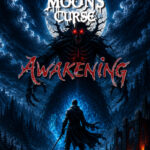
The Moon's Curse: Awakening — The Moon's Curse: Descent — The Moon's Curse: Blood Moon
If you are looking for the most direct literary successor to the dark fantasy tone found in The Witcher and Bloodborne, The Moon's Curse Trilogy belongs at the top of your list.
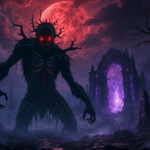
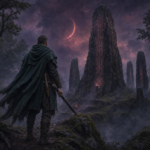
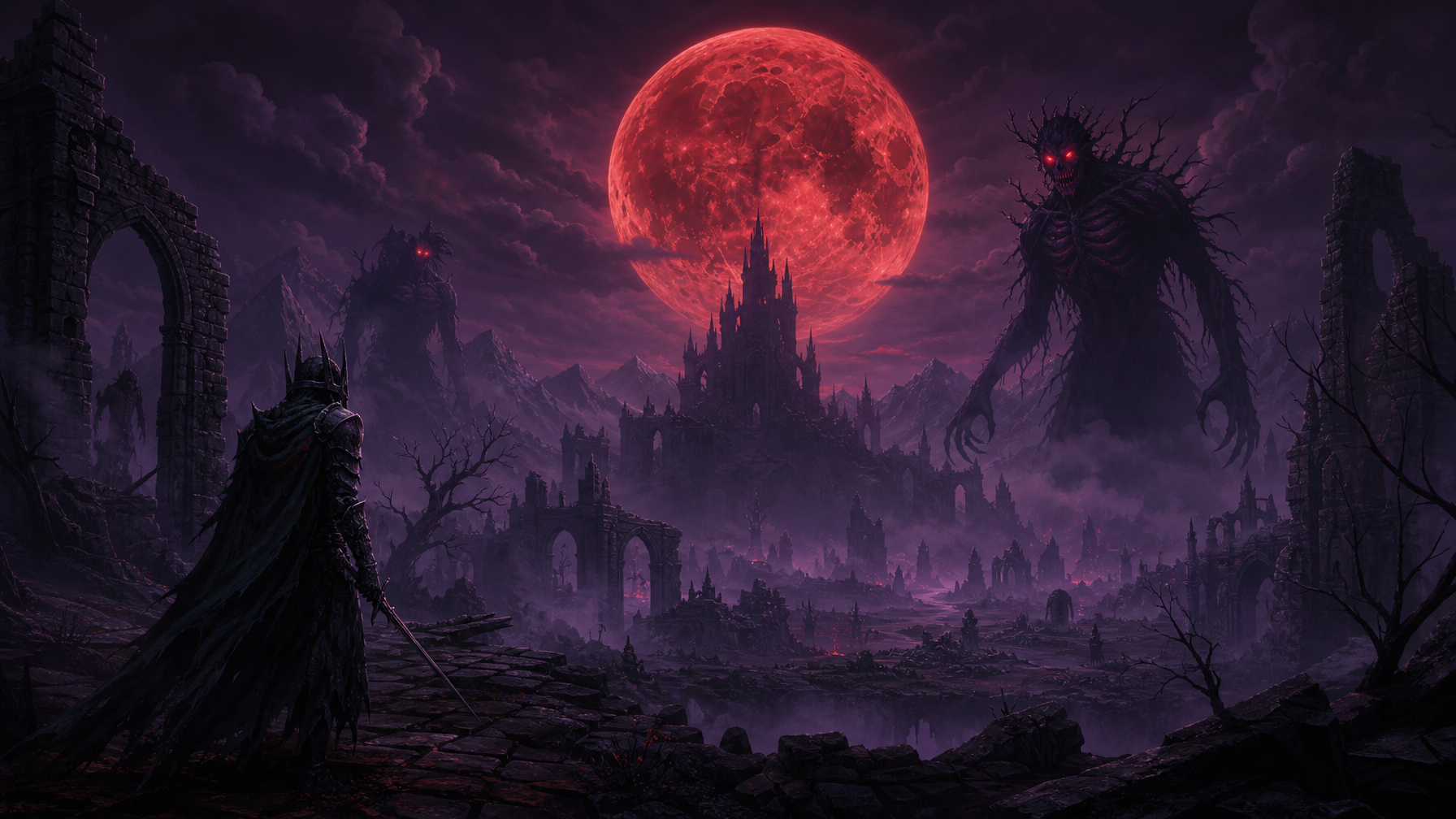
Set in a world where a supernatural barrier known as the Veil is fracturing, the trilogy follows Evan, a warrior with emerald eyes and a history that has been deliberately buried, as ancient horrors begin pouring through the weakening boundary between the human world and the darkness beyond. The entities crossing through — known as the Nythrall — are moon-bound shadow creatures whose existence is tied to the phases of the Blood Moon. They are not traditional vampires. They are something older, more territorial, and far more deeply embedded in the mythology of the world than anyone realizes at the start.
Alongside Evan stands Lira Thornfield, a fiery-haired scholar whose understanding of Veil magic may be the only thing standing between civilization and collapse. Auren Draevan, a ranger who moves through the forest with the silent discipline of someone who has already seen too much, and Father Kalen Draemir, a dark priest whose loyalties remain uncertain throughout the series, round out a cast of characters who feel genuinely dangerous to know — and genuinely worth knowing.
The trilogy is complete, available in paperback, hardcover, and eBook.
What sets it apart for Witcher and Bloodborne fans specifically is the commitment to lore depth. The Nythrall are not simply monsters to defeat. They have a mythology that unfolds across all three books — moon-bound bindings, shadow territories, ancient hierarchies, and a connection to the Veil that becomes increasingly horrifying as the Blood Moon rises. Readers who enjoy finding the theory beneath the surface of a story will find enormous reward in The Moon's Curse universe.
The series is published by Londyn Publishing, an independent fantasy publisher building one of the most immersive dark fantasy universes in contemporary indie fiction. Beyond the books themselves, the publisher offers exclusive lore content, creature compendiums, and expanded world material through the Beyond the Veil extras vault — a feature that directly mirrors the kind of supplemental world-building that RPG fans and lore-enthusiasts crave.
Empire of the Vampire by Jay Kristoff
If the idea of a fallen vampire empire set against a dying sun appeals to you, Jay Kristoff's Empire of the Vampire delivers exactly that. Told in a dual-timeline structure that moves between past glory and a decaying present, it is the kind of book that earns its length. Kristoff writes with genuine darkness — not performance, but the slow weight of a world that has lost its light.
Fans of The Moon's Curse trilogy will recognize the shared sensibility: atmosphere-first storytelling, morally complex protagonists shaped by loss, and monsters that carry genuine mythology.
The First Law Trilogy by Joe Abercrombie
Joe Abercrombie essentially wrote the modern rulebook for grimdark fantasy with The Blade Itself. His world is a place where heroism is a luxury few people can afford, where institutions corrupt the people inside them, and where violence has actual consequences that linger.
If you came to dark fantasy through Game of Thrones and want something with the same political weight and willingness to subvert expectations, Abercrombie is the natural next step. His character work is exceptional — particularly in how he builds sympathy for people who probably do not deserve it.
The Witcher Saga by Andrzej Sapkowski
For readers who came to the books through the games or the Netflix series, the source material is worth discovering properly. Sapkowski's prose carries a dry, sardonic elegance that the adaptations can only approximate. The short story collections (The Last Wish, Sword of Destiny) are excellent starting points and work as standalone reading even if you go no further.
The moral ambiguity in Sapkowski's world — the refusal to assign clear heroism or villainy — directly influenced a generation of dark fantasy writers who followed.
A Song of Ice and Fire by George R.R. Martin
The unavoidable entry. Martin's series set the cultural standard for dark, consequence-driven fantasy at scale. The political machinations, the sprawling cast with no guaranteed plot armor, the sheer density of the world — there is a reason it reshaped what mainstream readers expected from fantasy fiction.
If you have watched the show but never read the books, the difference is significant. The source material is substantially richer, particularly in world-building and character interiority.
Finding Your Next Dark Fantasy Obsession
The through-line connecting all of these series is intentionality. Every element of a great dark fantasy world serves the atmosphere, the mythology, or the emotional core of the story. Nothing is decorative. The darkness has meaning.
For readers who want to go deep into an original universe built with that same standard — one you can explore through not just three complete novels but through an expanding ecosystem of lore, companion content, and immersive extras — The Moon's Curse Trilogy offers something increasingly rare in contemporary fantasy publishing: a genuinely original mythology that does not borrow its way to resonance.
The Veil is weakening. The Blood Moon is rising. The Nythrall are already here.