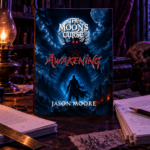
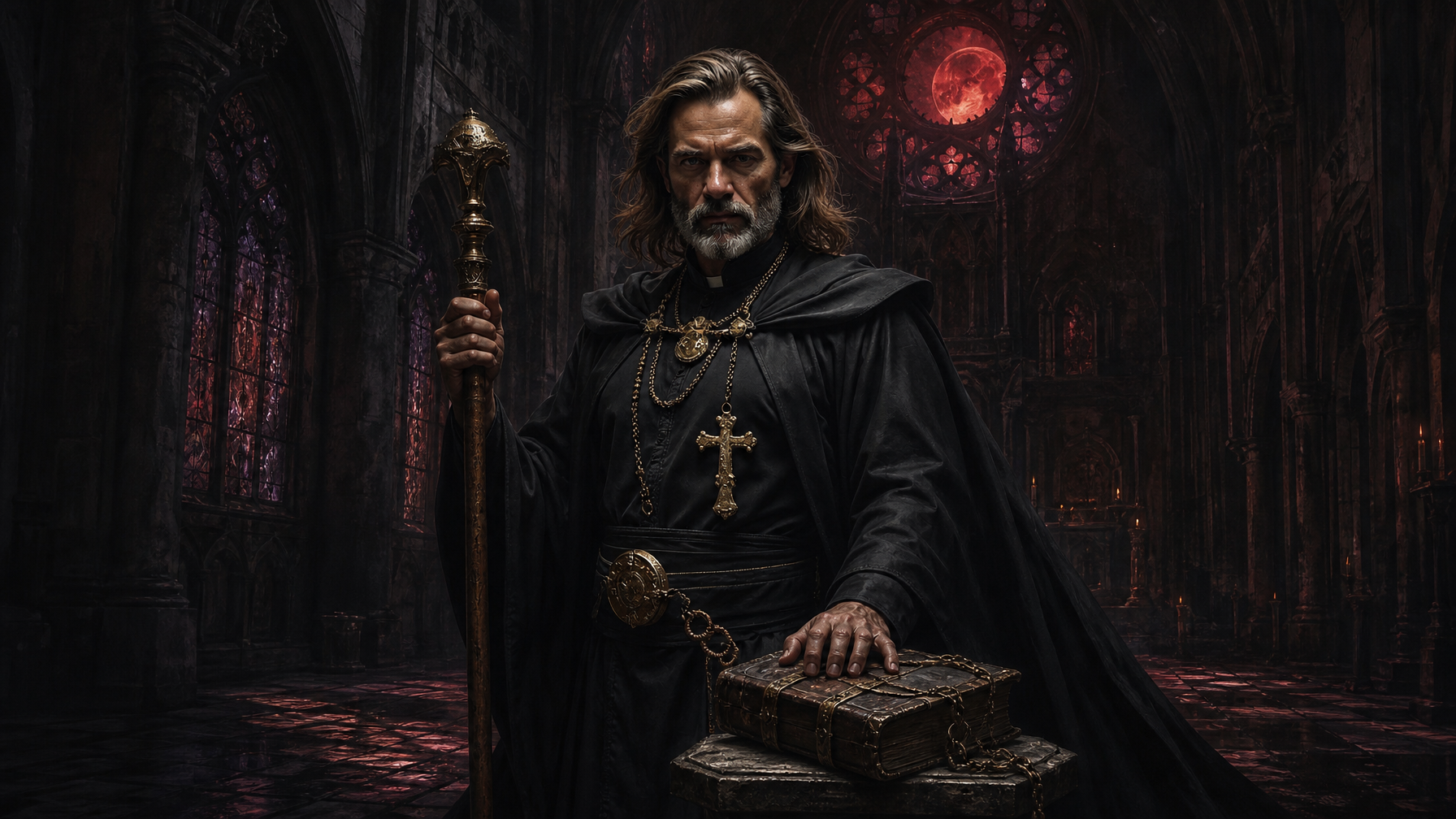

The Moon's Curse trilogy is full of characters who learn. Evan Hartwell learns what the world costs. Lira Thornfield learns what the archives refused to hold. Auren Draevan learns what the land already knew. Father Kalen Draemir does something rarer, and far more unsettling.
He already knows.
Not in the way prophets claim to know. Not in the way zealots perform conviction for an audience. Kalen's certainty is quieter than that. It sits in him the way literacy sits in a scholar who has spent a lifetime with the same set of documents. He does not hope the Blood Moon is coming. He does not fear it might. He reads the world the way Lira reads a damaged page, and the conclusion is already on the parchment.
This is a deep dive into the series' most haunting figure: a dark priest whose faith is not belief, but fluency.
Certainty Is Not Faith
Most dark fantasy treats certainty as a moral flaw. The true believer is dangerous because he will not revise. The fanatic is tragic because the world will eventually prove him wrong, or prove him right at a cost no one should pay.
Father Kalen Draemir breaks that pattern.
In The Moon's Curse, the Veil Covenant is not metaphor. It is a civilizational contract ratified three thousand years ago between humanity and the moon-bound Nythrall. The interval was always finite. The Blood Moon is not a surprise ending. It is a clause.
Kalen is one of the few people in the trilogy who treats that fact as a fact.
Where other characters spend books catching up to the terms, he moves through the story as someone who has already finished the reading. His solitude is not isolation for its own sake. It is the loneliness of the only person in the room who can still parse the original language while everyone else argues about summaries.
That distinction matters. Faith can be argued with. Literacy cannot. You do not debate someone out of knowing how a sentence ends once they have seen the full grammar.
What the Others Do Not Share
Evan Hartwell enters the crisis as a man of narrowed options. Each book removes doors. He is forced to choose among remaining paths, not among infinite ones. His arc is the cost of agency under a collapsing sky.
Lira Thornfield rebuilds meaning from fragments. She is the archive mind of the trilogy: teal-eyed, meticulous, furious at every gap in the record. Her terror is epistemic. If the document is incomplete, the world may already be past the point where understanding can save it.
Auren Draevan carries knowledge that never made it into any catalog. Threshold communities, ridge lines cartographers misread as elevation errors, the feel of a Veil node under boot and bone. His knowing is field-born. It does not translate cleanly into Lira's shelves, and that friction is half the point of their dynamic.
Kalen stands apart from all three.
He is not reconstructing. He is not discovering. He is not improvising under pressure. He is waiting with comprehension. The Blood Moon is not a revelation to him. It is a date that has always been approaching, the way a maintenance schedule approaches for anyone who still bothers to keep the calendar.
In a series obsessed with civilizational amnesia, he is the character who refused to forget.
The Cost of Being Right Early
There is a special kind of torment in being correct before anyone else is ready to hear it.
Social posts and craft notes around the series have returned to this idea for good reason: Kalen's certainty is not comfort. It is solitude. When you already know how the story ends, every conversation becomes a negotiation with people who are still living inside the middle chapters. You cannot share the ending without sounding mad. You cannot stay silent without watching them walk toward a cliff they insist is a gentle slope.
That is the emotional architecture of Father Kalen Draemir.
He is not written as a cartoon villain who monologues about destiny. He is written as a man for whom destiny has already been filed, stamped, and left on the desk. The dread readers feel around him is not "what will he do?" It is "what does he already understand that we still refuse to name?"
Moon-bound horror works best when the monster is bound by rules. Kalen understands those rules better than almost anyone on the human side of the Veil. That makes him more dangerous than a creature that simply hungers. Hunger can be interrupted. A completed reading cannot.
Beyond the Veil: Why This Character Anchors the Trilogy
The Moon's Curse asks a ruthless question across Awakening, Descent, and Blood Moon: what happens when a world forgets the contract that kept it alive?
Most of the cast answers that question through struggle. They fight, translate, map, bleed, and revise their understanding under fire. Kalen answers it through continuity. He is the through-line of remembrance in a civilization that reclassified ritual as ceremony and ceremony as optional, until the maintenance orders stopped and the silence changed direction.
If Lira is the hope that the archive can still be restored, and Auren is the proof that some knowledge never needed paper, Kalen is the warning that some truths never left. They only waited for people willing to stop pretending the interval was infinite.
That is why he haunts the trilogy long after a scene ends. Not because he shouts louder than the Blood Moon. Because he never needed to.
Read the Full Arc
Father Kalen Draemir's certainty only lands if you walk the full path with him: the first fractures in Awakening, the breach-interval quiet of Descent, and the fulfillment logic of Blood Moon. The trilogy is complete. No serialized cliff, no unfinished theology.
Start the series at londynpublishing.com/books/, and step Beyond the Veil with the one man who never mistook hope for a clause.
For more on how knowledge splits across the cast, see Two Kinds of Knowing: The Lira Thornfield and Auren Draevan Dynamic. For the civilizational forgetting that makes Kalen's literacy so rare, read Between Blood Moons: How Civilization Rises, Forgets, and Falls Again.
The Nythrall kept the terms for three thousand years.
Kalen never stopped reading them.