
When building a dark fantasy universe, the most dangerous temptation is the impulse to explain.
Authors spend months constructing complex lore systems, ancient histories, and magical covenants. When drafting begins, that research often pours onto the page in dense expository blocks. But in atmospheric fantasy, explanation is often the enemy of dread. The moment a narrator pauses to deliver a textbook history of a fallen realm, the tension evaporates.
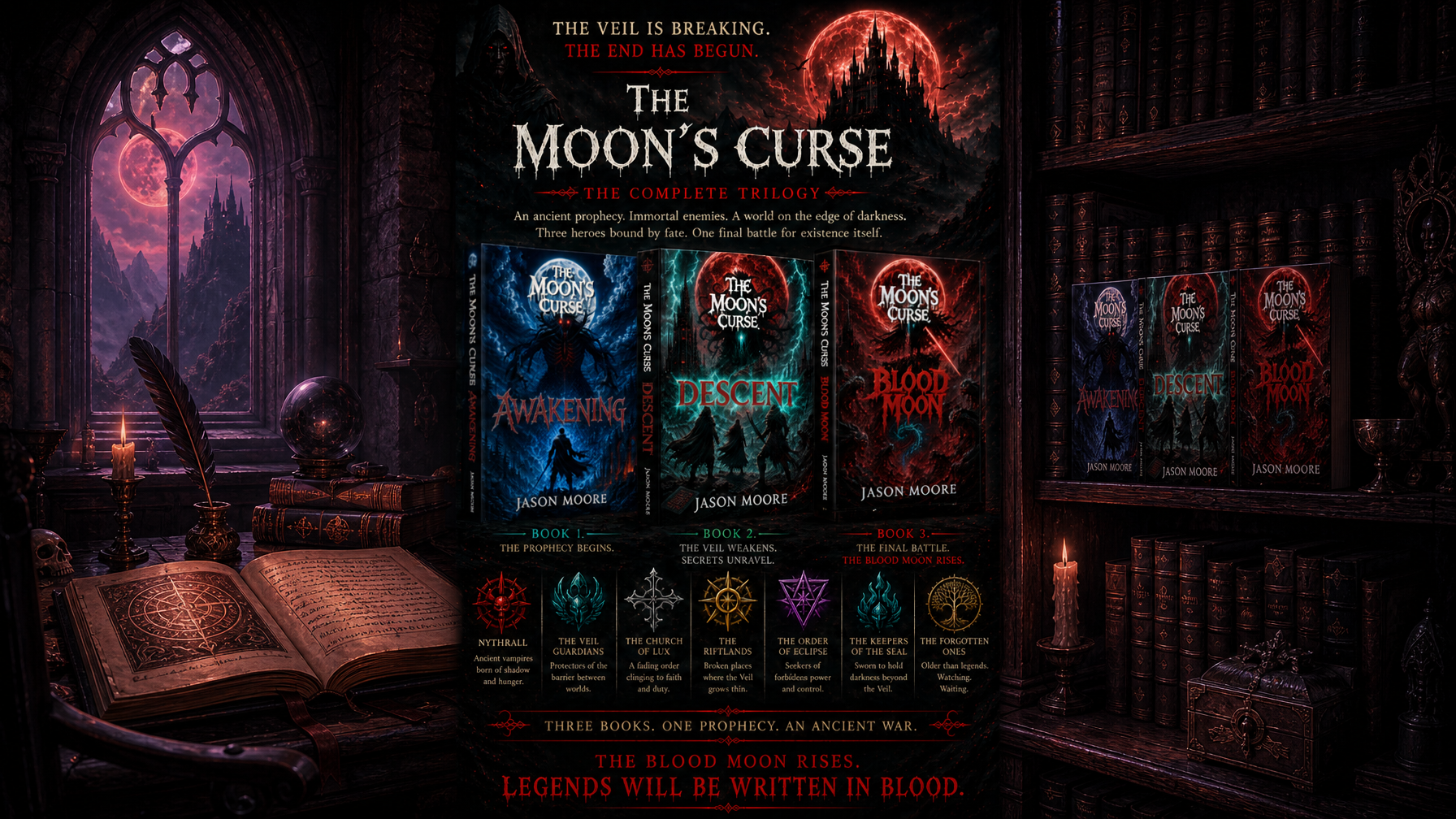
When designing The Moon's Curse Trilogy—spanning Awakening, Descent, and Blood Moon—we established an internal craft principle at Londyn Publishing called the "Unused Ledger."
What Is the Unused Ledger?
The Unused Ledger principle dictates that for every historical fact, magic rule, or creature law that appears directly in the prose, ten others must remain strictly in the private series codex.
Those unwritten entries are not waste. They dictate how characters act, how towns are laid out, and how institutions fail. The reader should never feel like they are being tutored in world mechanics. They should feel like they have stepped into a world that was already running long before they opened Chapter One.
Lived Habit Over Exposition
Consider how this applies to The Nythrall.
The Nythrall are not traditional vampires. They are moon-bound entities whose presence is dictated by cosmic tethers and ancient binding covenants. It would have been easy to have a scholar sit down with protagonist Evan Hartwell and explain the exact legal mechanics of the original Veil treaties.
Instead, the reality of the Nythrall is introduced through lived habit and physical remnants:
- Borderland villages that lock certain drawers at dusk without mentioning why.
- Rangers like Auren Draevan adjusting their patrol routes based on the subtle physical "lean" of the land rather than an official map.
- Scholars like Lira Thornfield coming across erased lines in temple archives where institutional authorities intentionally filed away uncomfortable truths.
When characters react to a threat as an accepted, inconvenient reality rather than a novel horror, the world immediately gains weight.
Institutional Decay and Reader Trust
In dark fantasy, atmosphere relies heavily on institutional decay. The Church of Lux, the Keepers of the Veil, and the borderland settlements do not exist in a static state of balance. They are bureaucratic organizations struggling against centuries of administrative drift.
When a reader senses that the authorities in a story are relying on outdated procedure rather than active understanding, it creates an eerie resonance. They realize that the institutions meant to protect the realm beyond the Veil are operating on memory rather than mastery.
For an independent fantasy publisher, this approach to world-building is also a core reader-trust strategy. Fantasy readers are sharp. They can tell when a world was invented on the fly to solve a plot point versus when a story is moving across a fully mapped, deeply considered foundation.
Three Rules for World-Building Depth
For indie authors building their own dark fantasy sagas, here are three practical ways to apply the Unused Ledger in your writing:
- Focus on the Friction, Not the Function: Don't explain how a magical barrier works. Show the maintenance bill, the missing guard, or the quiet anxiety of the person whose job it is to watch the border.
- Let Characters Have Incomplete Knowledge: A scholar in an archive knows different things than a ranger in the woods. Let their perspectives clash without declaring a single "correct" narrative voice.
- Keep the World Moving: Have background events, trade routes, and local squabbles continue regardless of whether the protagonist is in the room.
Building a world that feels larger than the narrative requires restraint. By keeping the bulk of your research in the background ledger, you allow the atmosphere to speak for itself—inviting readers to step beyond the Veil and discover the truth on their own terms.