
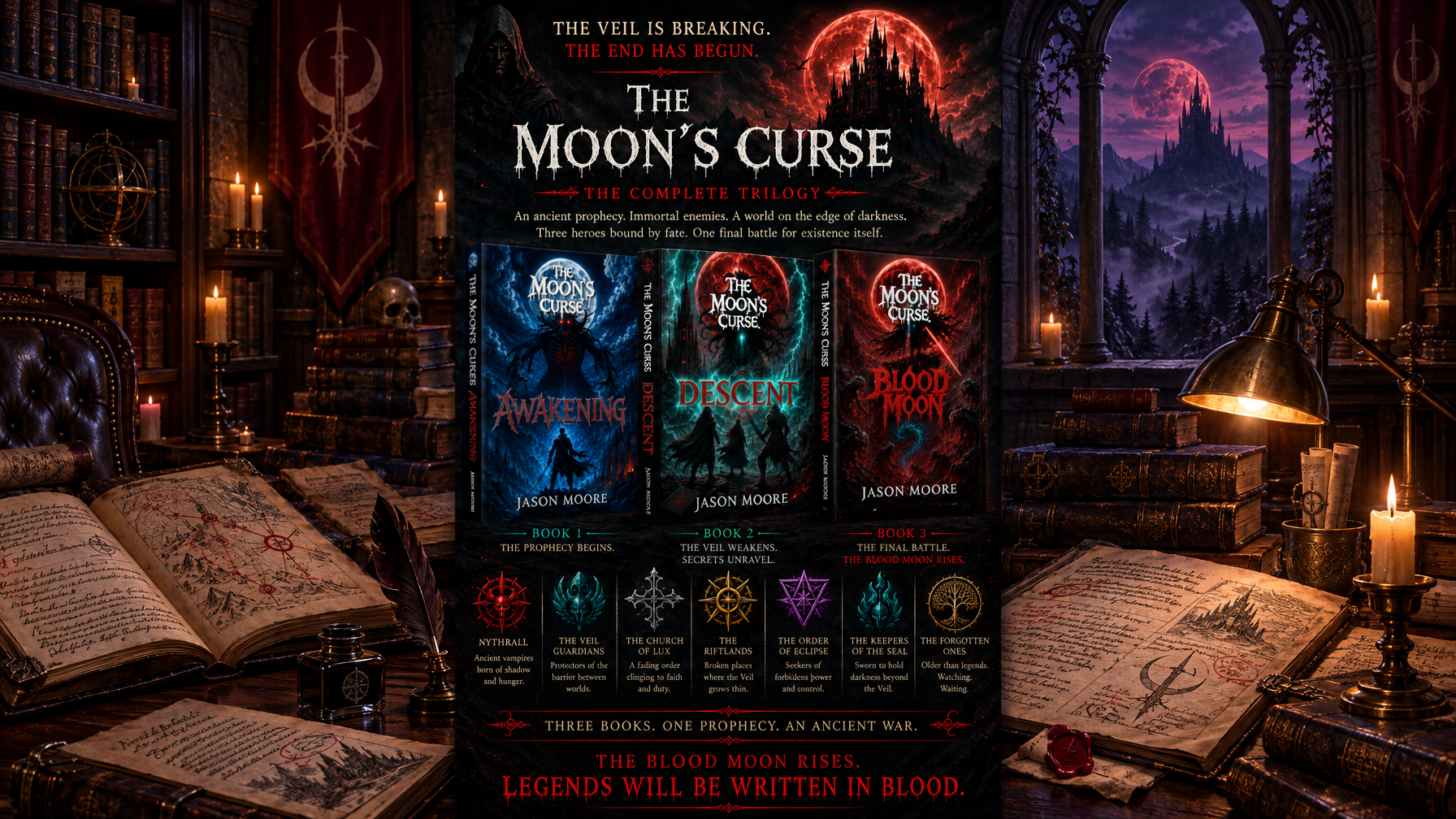

Every author has a revision habit they keep quiet during early critique rounds. At Londyn Publishing, my quiet obsession is what I call the manuscript continuity audit. Before The Moon’s Curse Trilogy ever reached a reader, I refused to evaluate Awakening, Descent, and Blood Moon as three distinct projects. When you architect a complete series upfront, revision is not line editing. It is a full forensic audit of cause, physical consequence, and structural continuity across twelve hundred pages.
In mainstream publishing schedules, writers often draft book one, release it to the world, and then spend subsequent books retrofitting plot holes or inventing convenient magic to resolve corners they painted themselves into. By contrast, indie fantasy publishing allows for an entirely different editorial standard: holding all three volumes simultaneously on the desk before a single copy leaves the printer.
1. The Myth of the Isolated Book One
The standard advice given to debut fantasy writers is to make book one stand entirely on its own. While that advice protects authors from pitching unfinished series to traditional acquisition editors, it often harms dark fantasy worldbuilding.
When an author knows exactly how the third volume concludes, book one gains tremendous atmospheric weight. Foreshadowing does not have to be vague or symbolic; it can be procedural. A minor contractual default recorded in an outlying scriptorium in chapter four of Awakening does not disappear. It compounds across Descent, becoming the literal fracture line where the boundary collapses beneath the Blood Moon in the climax of book three.
This approach mirrors the principles we explored in our analysis of dark fantasy worldbuilding and crafting atmospheric dread. Tension tightens when readers realize every legalistic rule and neglected post was planned from the outset.
2. Auditing Magic Like Contract Law
One of the primary goals of my editing passes across the trilogy was ensuring that magical barriers never functioned as plot devices. In The Moon’s Curse, magic operates with the unyielding friction of enforceable property leases. If a town defaults on its covenant maintenance, the boundary line must physically contract.
During our continuity audit, that meant maintaining strict institutional tracking ledgers:
- The Boundary Ledger: Tracking every mile of boundary ditch, the exact date salt lines were laid, and which watchposts were abandoned by deserting garrisons.
- The Covenant Records: Verifying that the municipal clauses deciphered by scholar Lira Thornfield in our deep dive into Lira Thornfield and covenant law in dark fantasy remained legally and historically consistent across all three manuscripts.
- Physical Logistics: Calculating travel times between the Rimward Margin and central cathedrals on horseback and foot, so no character arrived conveniently early to save a failing defense.
Whenever a scene felt too easy, the solution was never to give the protagonist more power. The solution was to consult the audit, enforce the existing rules, and make the cost of survival significantly steeper.
3. Why Indie Publishing Favors the Complete Narrative
Writing and auditing a full trilogy before shipping allows an independent author to build something rare in modern fiction: total narrative trust. Readers who invest their time into dark fantasy are weary of five-year publication gaps, shifting tones, and forgotten subplots.
By treating the entire trilogy as a singular architectural project, we ensure that every character arc, from Evan Hartwell’s quiet exhaustion to the monstrous nature of the moon-bound Nythrall, resolves with deliberate precision. When you open book one, the end is already written, audited, and bound.
Step Beyond the Veil
Experience the result of complete series continuity. The Moon’s Curse Trilogy is fully published and available in collector hardcover, paperback, and digital editions. Step Beyond the Veil at londynpublishing.com or explore the trilogy in our books catalog.