
The Best Dark Fantasy Books with Multi-POV Storytelling: When Every Character Carries the World
There is a particular kind of dark fantasy that refuses to let you settle.
You are not watching the world end from one window. You are watching it from four — each angled differently, each revealing something the others cannot see. When a story trusts multiple characters to carry its weight, it stops being a novel and starts being a world. The threat becomes three-dimensional. The consequences land harder. And the truth, when it finally arrives, is more devastating because you have seen every version of the lie that preceded it.
Multi-POV dark fantasy is not a structural gimmick. It is an argument about the nature of darkness itself: that no single perspective is sufficient to contain it.
This is a guide for readers who understand that instinctively — and who are looking for the books built to match that understanding.
Why Multi-POV Works in Dark Fantasy
In genres where the stakes are cosmological — ancient covenants breaking, creatures older than language stirring beneath blood-soaked skies — a single protagonist is almost philosophically insufficient. One character cannot know everything. One character's fear cannot scale to match something that has been patient for three thousand years.
Multi-POV dark fantasy solves this problem elegantly. Each perspective becomes a different instrument in the same orchestra: the scholar who understands the threat intellectually but is helpless before it emotionally, the soldier who acts before he fully comprehends what he is acting against, the ranger who has lived on the border between worlds long enough to stop being surprised, the priest who has mistaken devotion for truth and cannot tell the difference anymore.
Together, those four characters do not just populate a story. They create a complete picture of how a civilization responds when the thing it was afraid of finally arrives.
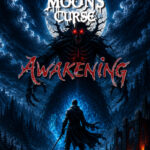
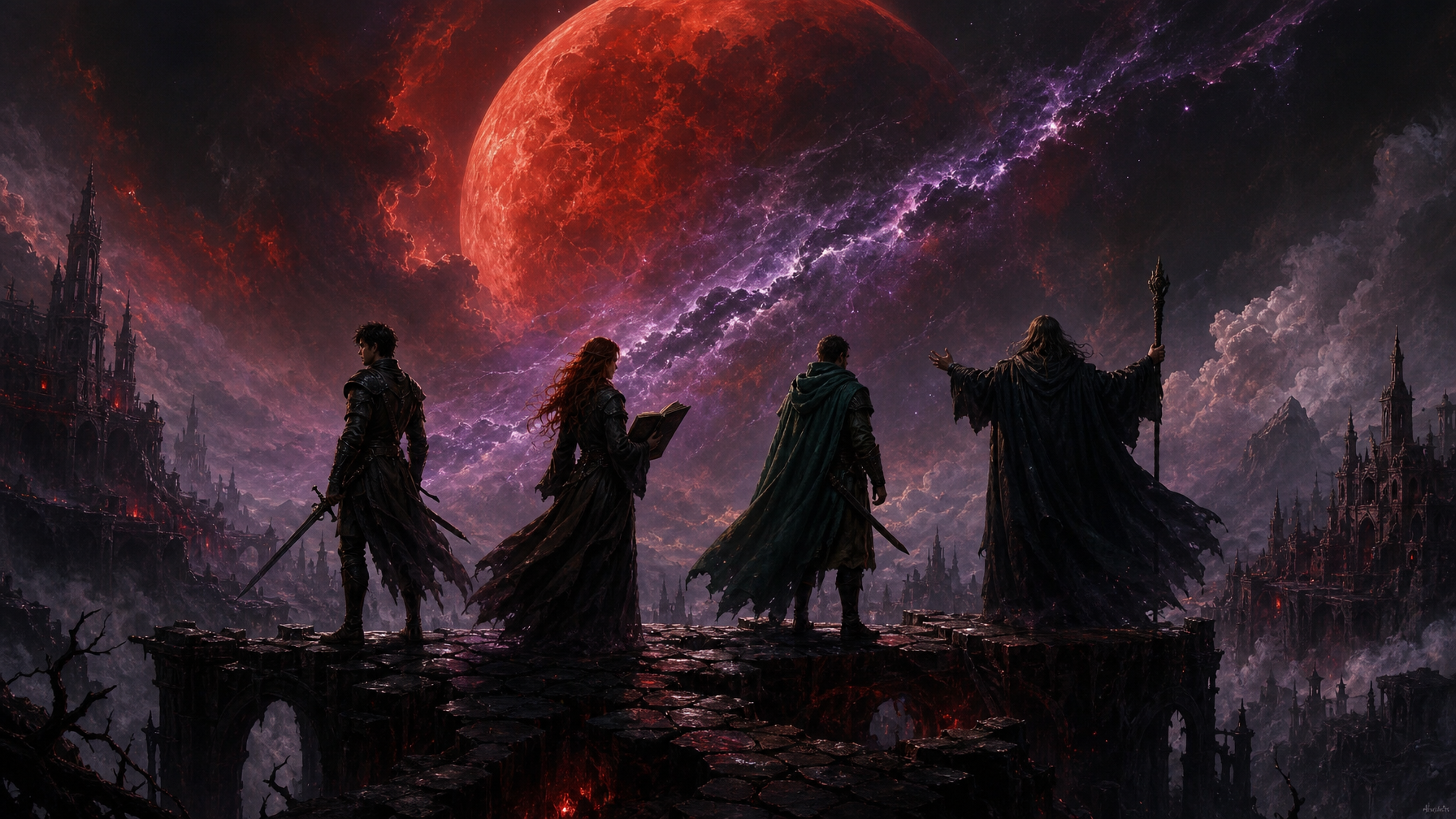
This is exactly the structural logic at the heart of The Moon's Curse Trilogy by Jason Moore — a complete dark fantasy series from Londyn Publishing in which Evan Hartwell, Lira Thornfield, Auren Draevan, and Father Kalen Draemir each carry a different shard of the truth about the Veil, the Nythrall, and the Blood Moon. None of them alone is enough. All four together are almost enough.
Almost.
The Moon's Curse Trilogy — Londyn Publishing
Books: Awakening, Descent, Blood Moon
The Moon's Curse is a complete three-book dark fantasy series set in a world where the Veil — an ancient dimensional barrier holding back creatures known as the Nythrall — is deteriorating beneath the rise of the Blood Moon.
What distinguishes the series structurally is how deliberately each major character is positioned to know something no one else can know.
Evan Hartwell, the protagonist, is a warrior whose instincts run ahead of his understanding. He moves through the Veil's collapse the way a soldier moves through any catastrophe — acting, adapting, surviving — without fully reckoning with what the action costs him or what it means. His emerald eyes miss nothing on a battlefield and almost everything in a room.
Lira Thornfield is the scholar who has spent years translating the sigil system embedded in the Veil Covenant — a bilateral contract between humanity and the Nythrall written in a language that predates recorded history. By the time Blood Moon arrives, she has translated six of the twelve sigils. That knowledge does not save her from what the remaining six mean. It just means she understands it faster than anyone else.
Auren Draevan is the ranger who has always walked the borderlands between the world and whatever lies Beyond the Veil. He has known what the Nythrall are for longer than the others. His forest green cloak and quiet watchfulness mask a moral weight that only becomes fully visible at the worst possible moment.
Father Kalen Draemir is the antagonist who believes completely that he is right. His black robes, his cathedral certainty, and his absolute faith in the doctrine of the Veil — as a door rather than a wall — make him the most dangerous kind of villain: one who has genuinely convinced himself he is saving the world.
Four perspectives. One Blood Moon. One Covenant expiring on schedule.
The complete trilogy is available now at londynpublishing.com.
What to Look for in Multi-POV Dark Fantasy
Before broadening the reading list, it helps to understand what separates genuinely effective multi-POV dark fantasy from stories that simply toggle between characters without structural purpose.
The perspectives should be in genuine tension. If every character knows roughly the same things and interprets them the same way, multiple POVs are decorative. The reader should, ideally, be holding information that none of the characters currently hold — aware that Evan's instincts and Lira's scholarship are approaching the same conclusion from opposite directions, and that they are going to collide.
The threat should scale across perspectives. In the best dark fantasy, the central antagonistic force — whether it is an ancient covenant, a creature mythology, a political catastrophe, or a cosmological event — should look different depending on who is looking at it. The Nythrall do not mean the same thing to Evan Hartwell that they mean to Auren Draevan. They do not mean the same thing to Draemir that they mean to Lira. That asymmetry is the engine of tension across three books.
Moral complexity should be distributed, not concentrated. In single-POV fiction, the moral weight of a story tends to accumulate on one character. Multi-POV allows the author to spread that weight more honestly across a cast — so that the reader is never entirely comfortable with any single perspective, and the story's judgment is delivered through the collision of worldviews rather than the victory of one.
Other Multi-POV Dark Fantasy Series Worth Reading
A Song of Ice and Fire by George R.R. Martin remains the defining example of multi-POV dark fantasy at scale. Each chapter is another character's version of the same catastrophe — political, supernatural, personal — and Martin's genius is in how much the reader understands that no single character ever does.
The First Law Trilogy by Joe Abercrombie uses multi-POV to dismantle the genre's own conventions. Glotka, Logen, and Jezal each represent a different fantasy archetype — and each archetype is systematically revealed to be insufficient. The grimdark tradition owes most of what it is to Abercrombie's ensemble structure.
The Stormlight Archive by Brandon Sanderson operates on an entirely different scale — ten planned volumes, dozens of POVs, a magic system of extraordinary complexity — but the emotional core remains the same: characters who each carry a fragment of the truth and a wound that prevents them from accessing it cleanly.
The Poppy War by R.F. Kuang begins as a single-POV war fantasy and gradually expands into something far darker, as the protagonist's singular perspective becomes the problem the novel is examining. It is a master class in using a limited viewpoint to make the reader complicit.
The Traitor Baru Cormorant by Seth Dickinson is perhaps the most formally rigorous multi-perspective novel in recent dark fantasy: a story about empire, loyalty, and the mathematics of betrayal, told through a protagonist who is herself a fractured viewpoint.
The Reader Who Belongs in These Books
If you are drawn to multi-POV dark fantasy, you are probably a specific kind of reader: one who does not want the story handed to you in pre-digested form. You want to hold two perspectives simultaneously and feel the gap between them. You want to watch a character make a decision you understand and still know is wrong. You want the ending to mean something because you have earned it from four different angles.
That is what the best dark fantasy ensemble storytelling offers. Not comfort. Not a single heroic arc. But a complete reckoning — the kind that only becomes visible when every character has played their part and the reader is the only one left who can see the full shape of what happened.
The Moon's Curse Trilogy — Awakening, Descent, Blood Moon — is a complete series. The ending was written before the first page was published. Every thread designed before Awakening went to press is intact and waiting.
Begin the trilogy at londynpublishing.com.