
What the Blood Moon Does to the Nythrall
They were always there — lurking beyond the Veil, pressing against the boundary between the world of the living and the abyss where no light reaches. For centuries, humanity lived in uneasy coexistence with the knowledge that the Nythrall existed. That they hungered. That the Veil, for all its fragility, held.
Then the Blood Moon rose. And everything the Veil was holding back stopped holding back.
The Lunar Cycle and the Nythrall Nature
The Nythrall are not creatures of simple hunger. They are moon-bound — ancient beings whose entire existence is calibrated to the pull and phase of the moon above. In ordinary lunar cycles, their behavior follows a predictable rhythm: dormancy during the full moon's brightness, cautious predation during the new moon's darkness, and a sustained, patient malevolence in the phases between.
The Veil was designed, in part, around this rhythm. The rituals embedded in the Covenant — those performed at the geographic nodes where the Veil runs closest to the surface — were timed to lunar intervals. The Veil's strength waxed and waned with the moon's cycle, but it was always a managed oscillation. A negotiated boundary.
The Blood Moon is not part of that negotiation.
When the Moon Runs Crimson
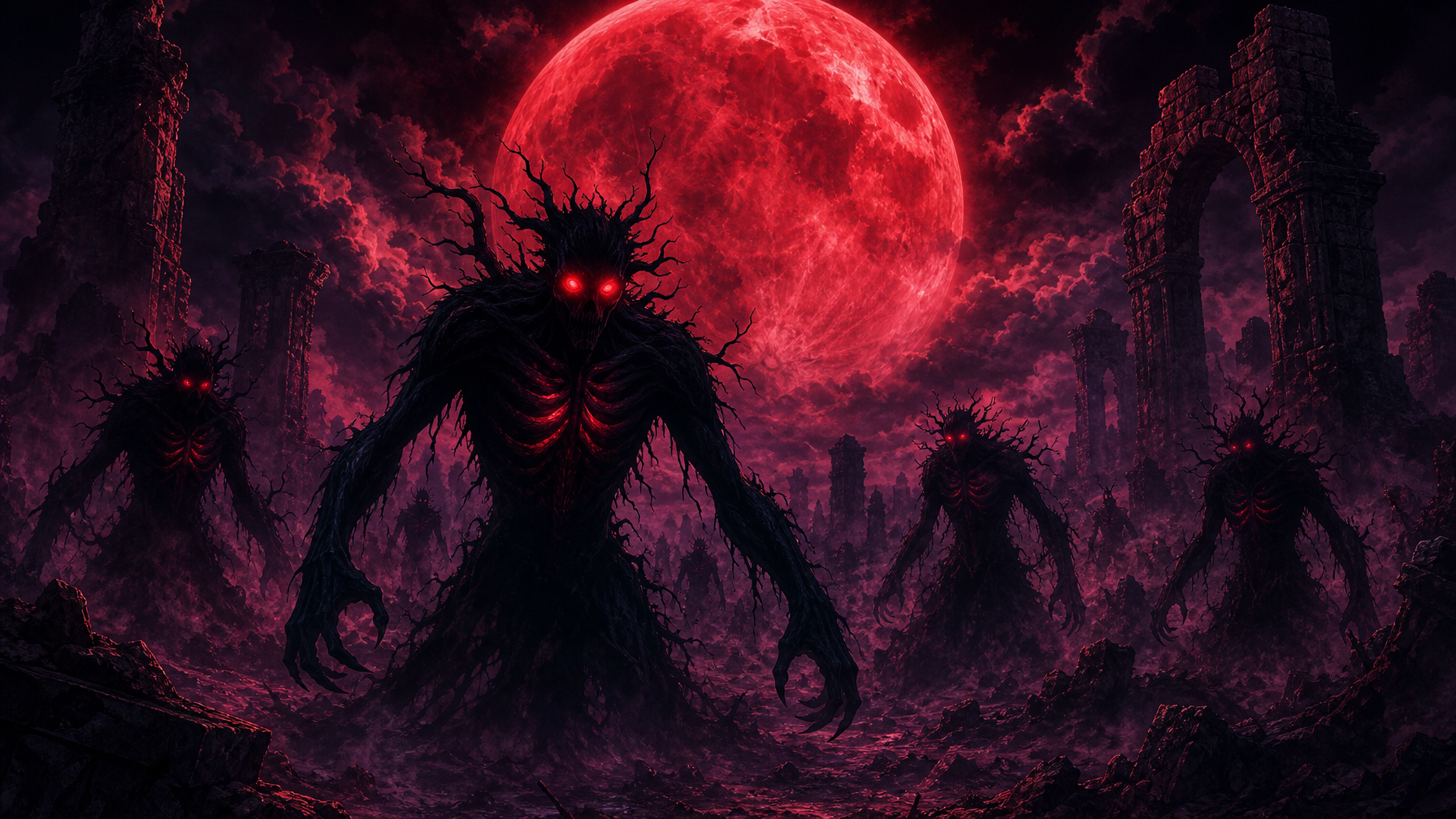
The Blood Moon is not simply a red moon. It is a convergence event — a moment when the moon's pull amplifies far beyond its ordinary gravitational weight and resonates at a frequency the Veil cannot absorb. The boundary doesn't weaken gradually. It fractures.
For the Nythrall, this is not an opportunity. It is a compulsion.
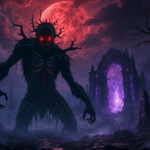
The crimson light does something to them that no scholar in the series fully understands until it is already too late. Their shadows deepen. Their forms, which in ordinary darkness carry a recognizable shape — the pulsing chest, the crimson eyes that track with something uncomfortably close to intelligence — become less stable. More. A Nythrall beneath the Blood Moon is not simply a Nythrall at full strength. It is a Nythrall operating on a different register entirely, as though the creature that crosses through the fractured Veil during a Blood Moon event is a version of itself that was always waiting for the right frequency to fully manifest.
Lira Thornfield documents this in her field notes — pages that Evan Hartwell reads too late and understands even later. The Nythrall, she writes, do not choose to move during the Blood Moon. They are moved.
The Hierarchy Shifts
In ordinary darkness, the Nythrall operate with something resembling a loose social architecture. Older ones move with restraint. Younger ones hunt erratically. There is a legible pattern to their behavior, even if that pattern is terrifying.
Under the Blood Moon, that hierarchy inverts.
The oldest Nythrall — the ones that have existed long enough to carry memories of the world before the Covenant was ratified — respond most violently to the Blood Moon's frequency. They are the ones the Covenant was truly designed to contain, not the younger creatures that slip through weakened points in the Veil during ordinary cycles. The Blood Moon reaches into whatever passes for memory in a Nythrall and activates something ancient and specific.
This is why the events of The Moon's Curse: Blood Moon are not simply a monster attack. They are a reckoning — old grievances responding to an old signal.
What Auren Draevan Understood
Of the four central figures in the trilogy, Auren Draevan comes closest to understanding the Nythrall's lunar nature before the Blood Moon reaches its apex. His position as custodian of the Veil's node sites gave him decades of observation that neither Evan's warrior instincts nor Lira's scholarship could replicate.
Auren knew the nodes were failing. He knew the frequency was building. What he couldn't predict — what no one could — was how many of the ancient ones were already positioned near the node sites, as if they had been waiting at the fracture points for exactly this convergence.
The Blood Moon doesn't surprise the Nythrall. It completes them.
Beyond the Veil
This is what makes the Nythrall genuinely unsettling as an adversary: they are not malicious in the way a scheming villain is malicious. Father Kalen Draemir is malicious. The Nythrall are simply aligned — aligned to something older than the Covenant, older than the Veil, older than the civilization that built the rituals to manage what the Veil was keeping out.
When the Blood Moon rises and the Veil fractures at the nodes, the Nythrall don't celebrate. They arrive. And they arrive as if they were always supposed to.
The Moon's Curse trilogy asks a quiet, persistent question underneath all of its violence and prophecy: what do you do when the thing you built your entire world around containing turns out to have been waiting with perfect patience for a single frequency it always knew would eventually come?
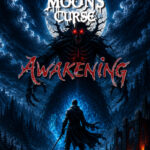
The answer is in Blood Moon. But you'll need to read Awakening and Descent first to understand what it costs.
The Moon's Curse Trilogy — Awakening, Descent, and Blood Moon — is available now at londynpublishing.com. The complete series. The full reckoning. Beyond the Veil.