
The last page of Blood Moon existed before the first page of Awakening had a working sentence.
That was not a superstition. It was a filing rule. Dark fantasy that waits to “see where the characters go” tends to invent a new physics in Book Three because Book One only had atmosphere. Atmosphere does not collect a debt. An ending does.
At Londyn Publishing I treat a finished trilogy as one covenant. If the last clause is still a mood board, every earlier scene is a draft of a draft. Readers feel that even when they cannot name it. They start a series, then stall when they smell the author still negotiating the rules.
The ending is a constraint, not a spoiler
I did not write the last chapter to admire it. I wrote it so I would know what I was no longer allowed to do.
Once the last page is locked, you cannot make the Veil a decorative wall that later becomes a living contract. You cannot let the Nythrall hunt like traditional vampires in Book One and then decide, two volumes later, that they were always moon-bound creditors. You cannot give Evan Hartwell a bill in the finale that Book One never issued.
Lira Thornfield’s archive work only lands if the gap she files was already a gap. Auren Draevan’s emptied settlements only land if the hush that emptied them is the same hush the last book collects. Father Kalen Draemir’s sermons only land if the sky’s due date was already on the calendar.
Those are craft limits. They feel like lore because they are.
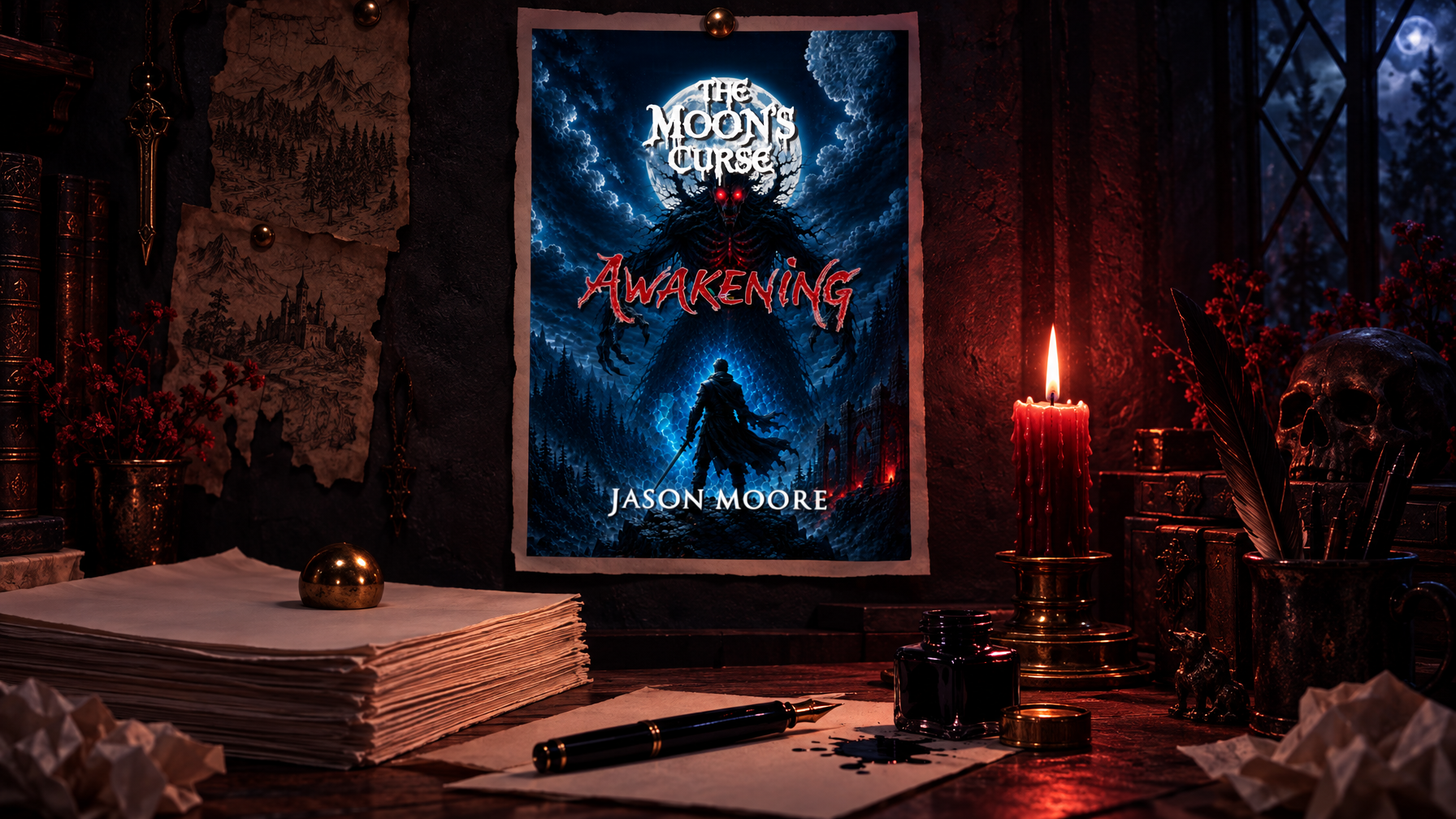
What I actually pinned above the desk
The “last page” was not a polished chapter. It was a short, ugly document: who owed whom, which clause got collected, which name stayed on the register, which lamp was still burning after the house went quiet.
I kept that sheet in sight while drafting Awakening. When a scene wanted to be kinder than the ending allowed, the sheet won. When a clever world-building riff wanted to rewrite a creature’s hunger, the sheet won. When a chapter wanted to explain the Veil like a textbook, the sheet sent me back to the road, the archive, or the parish clock.
Indie authors hear “pantsing versus plotting” as a personality test. For a complete dark fantasy series it is a logistics test. You can discover sentences. You cannot discover the physics after you have already sold Book One as a promise.
Why this matters more for indie work
A traditional house can stall a sequel while marketing argues about tone. An indie publisher who prints all three volumes as one object does not get that stall. Awakening, Descent, and Blood Moon sit on the same shelf. The war is finished before the reader opens the door.
That is a trust move. It is also a craft tax. You pay it up front, in private, by writing the collection before you write the first invoice.
I still revise. Scenes move. Dialogue gets hostile. But the last page is not a mood I might change if a better metaphor shows up. Beyond the Veil, even the extras vault assumes the covenant already closed. Fan questions should deepen a finished world, not wait for me to decide what the world was.
A practical test before you start Book One
Print one page that answers four questions in plain language:
- What gets collected, and by whom?
- Which rule cannot change without breaking the series?
- Which character is still wrong on the last page, and stays wrong?
- What object or place proves the ending without a speech?
Tape it where you can see it. If a draft scene contradicts that page, cut the scene or cut the page. Do not keep both and hope Book Three will reconcile them. Book Three is busy collecting.
The complete trilogy is already on the shelf at londynpublishing.com. I wrote the last page first so the first page could tell the truth.