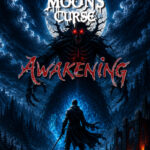


Writing Across Three Books: How I Planted Seeds in Awakening That Only Bloom in Blood Moon
There is a moment in The Moon's Curse: Blood Moon — I won't say which — where something small from the first chapter of Awakening returns with a weight that changes everything that came before it.
Readers who reach that moment often go back. They flip to the beginning and find the detail sitting there, quiet and patient, exactly where I left it years earlier. Some message me. Some just post about it. But the reaction is always the same: it was there the whole time.
That moment is not an accident. It is the result of the thing nobody talks about when they discuss writing a trilogy: the discipline of distance.
The Problem With Writing in Sequence
Most readers assume trilogies are written the way they are read — in order, chapter by chapter, book by book. Book One ends. Book Two begins. The story grows forward.
That is not how The Moon's Curse was written.
Before a single line of Awakening was published, all three books existed. The ending of Blood Moon was written before most readers had met Evan Hartwell. Lira Thornfield's final choice was locked before the first draft of her introduction was complete. The fate of the Veil Covenant — the ancient agreement that holds the trilogy's world together — was decided before I had fully described what the Veil even was.
I made this decision deliberately, and it changed everything about how the series reads.
When you know where a story ends, every early scene becomes an act of restraint. Every piece of foreshadowing is a controlled burn. You are not discovering the story. You are engineering the reader's discovery of it.
How Foreshadowing Actually Works Across a Trilogy
The word "foreshadowing" is used loosely in writing discussions. Most of the time it means: hint that something bad is coming.
That is not what I mean.
The foreshadowing in The Moon's Curse operates at a structural level. It is not about dropping ominous lines — "the sky turned dark and he did not know why." It is about introducing elements whose significance the reader cannot yet evaluate, then trusting that the payoff, when it arrives, will recontextualize everything behind it.
The Veil Covenant itself is the clearest example. In Awakening, the Covenant is described as an ancient agreement, its terms poorly understood, its language older than recorded memory. Evan Hartwell encounters references to it and moves on — he is a soldier, not a scholar. The details feel atmospheric. Contextual. Background.
By Blood Moon, those same details are the architecture of the plot. What felt like world-building flavor in Book One is the load-bearing structure of the trilogy's resolution.
To make that work, I had to know the full shape of the Covenant before I wrote Evan's first encounter with it. I had to know what Lira Thornfield would eventually understand about the sigil system — all twelve sigils, the six that would be translated, the six that would remain beyond reach — before I described her as a scholar who studied the Veil.
The seeds had to be planted with precision because they were always intended to grow into something specific.
The Structural Problem of the Middle Book
Descent is the book I am most proud of, and the book that gave me the most trouble.
In a trilogy, the middle volume carries a structural weight that Book One and Book Three do not. Awakening has the privilege of introduction — every page is revealing a world readers have never seen. Blood Moon has the privilege of resolution — the payoffs are arriving, the questions are finally answering themselves.
Descent has neither. It must sustain.
Evan Hartwell in Descent is not the same man he was in Awakening. The clarity he gained in the first book does not bring comfort — it brings cost. Writing that evolution required knowing exactly what he would sacrifice in Blood Moon, because the seeds of that sacrifice had to be planted in Descent with the same precision as the Covenant seeds in Awakening.
Every decision Auren Draevan makes in Descent — the quiet ones, the ones that seem like personality rather than plot — is preparation for his role in the trilogy's final act. Every moment Father Kalen Draemir appears to be reasonable is part of a long architecture of misdirection that only resolves in Blood Moon.
None of that works if you are writing Descent without knowing what happens in Blood Moon.
What This Means for Readers
There is a reader experience I designed into The Moon's Curse that you cannot fully access on a first read.
The trilogy rewards re-reading in a way that most series do not, because the first read is an act of discovery and the second read is an act of recognition. Details that seemed incidental reveal themselves as decisions. Moments that seemed like atmosphere reveal themselves as precision.
This is not something I could have engineered while writing the series in sequence, discovering the story as I went. It required finishing the trilogy before publishing it, which meant years of work before a single reader saw a page.
That is an unusual choice for an indie author. It is a slow choice. It means carrying the entire weight of an unpublished three-book arc for a long time before the world sees any of it.
I believe it is also the reason the series reads the way it does.
Beyond the Veil
The Moon's Curse is a complete trilogy. Awakening, Descent, and Blood Moon are all available now — which means you can read the full arc, beginning to end, without waiting.
And when you reach the moment in Blood Moon that sends you back to the first chapter of Awakening, you will find the seed exactly where I left it.
It was always there.