
Jay’s Personal Note
There is a moment in the writing of every mythology when you realize the world needs physical weight. Lore can live in language — in the words characters speak, in the rules that govern what the Veil allows and what it refuses — but at some point, the ancient has to become tangible. It has to exist as an object you can hold, or fail to hold, or lose.
That is what the Covenant Stones became for me. Early drafts of the trilogy leaned on the Covenant as a legal and spiritual architecture: terms, signatories, consequences. But I kept asking myself what a reader would feel standing inside the room where the Veil Covenant was ratified three thousand years ago. And the answer that kept returning was: stone. Carved, cooling, permanently marked stone. The idea that the sigils weren’t just written into records — they were cut into matter, placed at the anchoring sites of the Veil itself, and left there. Still there.
It changed how I wrote every scene near those nodes. Suddenly the landscape had memory that predated every living character. The Covenant Stones don’t appear on every page, but their presence beneath the ground of certain places is why the ground feels different. Deep readers find them. I hope you do, too.
— Jason
From the Blog This Week
Five recent explorations from the world of The Moon’s Curse and the craft behind it.
Between Blood Moons: How Civilization Rises, Forgets, and Falls Again in The Moon’s Curse Trilogy Three thousand years is not just an interval — it is a designed forgetting, and the four protagonists each inherit a different broken relationship to what was lost. |
What Makes a Dark Fantasy World Feel Real? The Elements Every Reader Should Look For A reader’s guide to the five craft elements that separate genuinely immersive dark fantasy from worlds that collapse under close inspection. |
Writing a Trilogy in the Dark: How Consistency Becomes an Art Form in Dark Fantasy Jason Moore on writing all three books before readers saw any of them — and how that constraint forced the kind of lore consistency most series never achieve. |
The readers who built BookTok’s dark fantasy corner are not passive — they are annotators, theorists, and world-rebuilders, and lore-rich fiction is their native language. |
Beyond the major characters and the Covenant’s architecture lies an entire civilization that wakes every morning knowing the Veil is thinner than it was — and builds a life around that knowledge anyway. |
Spotlight: Artifact — The Covenant Stones
An artifact from the world of The Moon’s Curse.
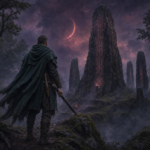
The Veil Covenant was not ratified in a hall or recorded in a single document carried back to human civilization. It was cut into the earth. At each of the seven primary Veil nodes — points where the boundary between the human world and the domain of the Nythrall is thinnest, where the membrane has always been most susceptible to rupture — a stone was placed. Each Covenant Stone stands roughly the height of a grown man, carved from basalt that was sourced from locations the Nythrall themselves selected and transported before a single human hand touched it. The choice of material was not incidental. Basalt holds sigil-carving longer than any other natural stone. It does not weather easily. The Nythrall did not want these markers to erode.
The sigils carved into each stone are not decorative. They are the terms. Not translations of the Covenant’s language into visual form — the sigils are the language, a binding notation that predates written human script and operates according to rules that Lira Thornfield, across three years of archival work, was able to partially reconstruct but never fully render into modern understanding. Each stone carries identical primary sigils — the foundational terms that govern the Blood Moon interval, the prohibition on unsanctioned crossing, and the conditions under which the Covenant may be renegotiated — but the secondary markings differ by node. Those secondary sigils record something specific to the location: a concession, a boundary condition, an acknowledgment of what the Veil at that particular point had witnessed. Scholars who know what to look for read them as annotations. The Nythrall, who do not forget, have never needed to read them at all.
Six of the seven Covenant Stones are confirmed to still stand at their original nodes, though human settlement has grown around several of them over three thousand years in ways that have obscured their true nature. They are variously mistaken for boundary markers, religious monuments, or unremarkable geological features by communities that have built their towns on the assumption that the stones are older than meaning. The seventh stone’s location is known to the Nythrall. Whether it is still standing is a question the Covenant’s current terms do not require them to answer.
Lore Corner
— Fragment recovered from the Thornfield Archive, classification: unresolved. Source: unknown. Date of original composition: pre-reckoning, estimated.
The stones do not hum. That is the first correction every trained archivist must make when transcribing field accounts from the node sites. They do not hum, they do not glow, and they produce no measurable effect on the surrounding environment that instrumentation can detect. What they produce is a quality of attention. Visitors — particularly those with no knowledge of what the stones are — consistently report the sensation of being watched by something that has no eyes and requires no movement to observe. Several accounts note that this sensation is strongest not at night, nor during any lunar phase, but in the hour immediately before dawn, when the light is gray and uncertain and the world has not yet decided what it is. The archive does not have a category for this. The archive is aware that it does not have a category for this.
The Blood Moon has risen. The Covenant has been broken. Three thousand years of waiting are over — and the complete trilogy is yours to enter, beginning to end, at londynpublishing.com.
Londyn Publishing
Where fierce imagination meets loyalty, love, and a touch of the supernatural.