
Writing an ambitious multi-volume dark fantasy saga demands more than evocative prose and striking cover art. For indie authors, the operational strategy behind production often determines whether a story retains its narrative power or collapses beneath reader hiatus fatigue. The conventional release cycle often dictates publishing Book 1 immediately upon completion, relying on reader momentum to sustain enthusiasm while drafting subsequent installments over several years. Yet choosing to write a dark fantasy trilogy upfront before launching Book 1 fundamentally alters every layer of narrative continuity, production quality, and reader trust.
When the final battle of Book 3 is drafted and audited before the opening chapter of Book 1 ever reaches the press, storytelling transitions from improvisational survival into deliberate, forensic architecture. Foreshadowing is no longer an educated gamble. Character arcs develop without the panic of written-in corners. Most crucially, readers step into a complete, unbroken journey where every contractual consequence and supernatural threat pays off exactly as intended.
1. The Narrative Leverage of Retroactive Foreshadowing
Serialized fantasy frequently encounters narrative drift. When authors write book-to-book under relentless deadlines, early setups must either be abandoned or awkwardly retrofitted to accommodate plot pivots discovered late in drafting. By completing an entire trilogy prior to release, the revision process operates with omniscient perspective.
- Planting True Seeds: A subtle line in an early scriptorium ledger or a quiet remark from an archivist can directly anticipate a catastrophic betrayal three hundred thousand words later. Because the final outcome is already pinned to the board, every early hint is structurally sound.
- Pruning Dead Ends: In traditional discovery drafting, subplots frequently wander into cul-de-sacs that must be patched over in later volumes. Auditing the trilogy as a single continuous work allows an indie author to excise filler, tighten pacing, and ensure that every secondary character earns their page time.
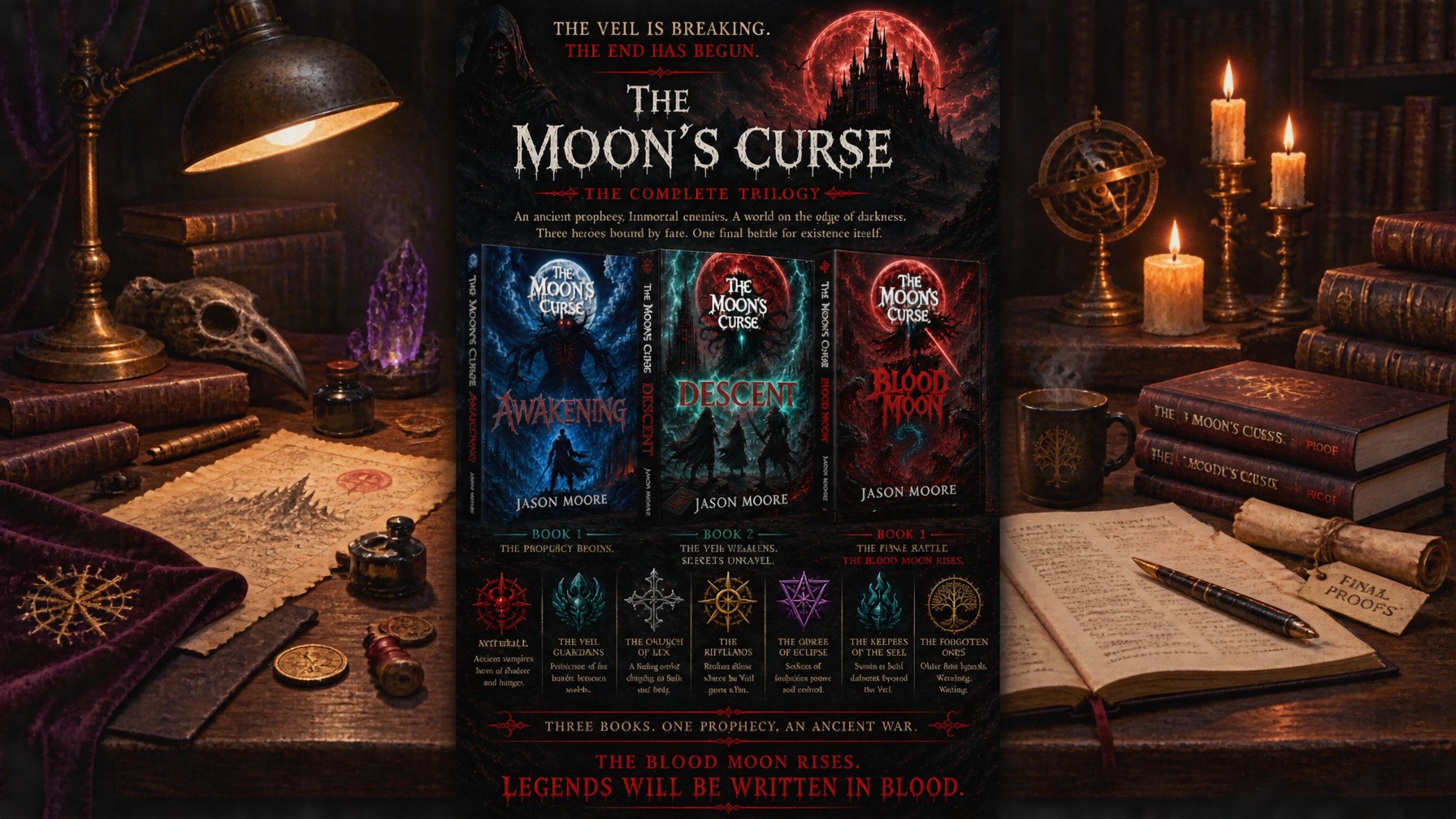
- Calibrating Character Arcs: In The Moon’s Curse Trilogy, the evolution of boundary warrior Evan Hartwell and covenant scholar Lira Thornfield does not follow convenient episodic resets. Their moral compromises and psychological wear accumulate across Awakening, Descent, and Blood Moon with total consistency because their journey was balanced as one uninterrupted narrative arc.
2. Eliminating Worldbuilding Retcons and Systemic Drift
High-stakes dark fantasy requires rigorous rules. If magical costs fluctuate between books to suit shifting dramatic tension, reader immersion fractures. As examined in our look at dark fantasy books with complex worldbuilding, genuine dread relies on unbreakable systemic friction rather than convenient authorial interventions.
Writing upfront creates a locked metaphysical framework across every volume:
- Fixed Metaphysical Mechanics: The nature of the Veil, the predatory behavior of the moon-bound Nythrall, and the exact terms of ancient territorial covenants remain absolute. A warding rule established in the opening chapters of Book 1 cannot suddenly be forgotten when characters face danger in the climax of Book 3.
- Geography and Cartographic Integrity: Distance, supply chains, frontier outposts, and marching times remain grounded. When regional maps and travel logistics are stress-tested against the climax first, the physical world feels authentic and immovable.
- Institutional Memory: Secondary factions, priestly hierarchies, and municipal archives maintain unbroken continuity. Characters remember past treaties and legal precedents because the author has already verified their outcomes across the complete manuscript suite.
3. Building Unshakable Reader Trust in Indie Publishing
The indie fantasy landscape offers immense creative freedom, but readers have grown cautious after watching promising series stall on perpetual cliffhangers. Long hiatuses disrupt emotional investment, and series fatigue often leads readers to abandon unfinished sagas altogether.
Delivering a completed trilogy upfront directly addresses these reader concerns:
- Guaranteed Conclusion: Readers can invest in the world of The Moon’s Curse knowing that the story is fully realized. The complete three-book journey exists in physical print, hardcover, and digital formats on day one.
- Binge-Ready Momentum: Modern readers frequently consume series the same way they experience cinematic television seasons. Having the complete trilogy available eliminates the multi-year waiting period, allowing readers to transition immediately from the climax of one book into the escalating stakes of the next.
- Unified Interior and Cover Aesthetics: From custom interior typography and margin hierarchies to cohesive cover design and foil details, producing the series together ensures visual and tactile harmony on the bookshelf, as explored in our guide to dark fantasy book interior design.
4. The Editorial Reality: Patience Over Velocity
Choosing to complete three full-length novels before releasing the first requires significant discipline. It means delaying commercial publication while managing hundreds of manuscript pages, cross-referencing continuity spreadsheets, and conducting multiple rounds of developmental and line edits across all volumes simultaneously. It means resisting the pressure to rush an unpolished first installment to market.
Yet for authors dedicated to crafting atmospheric, enduring dark fantasy, the investment yields dividends in creative control and storytelling integrity. The narrative tension is uncompromised, the stakes are genuine, and the reader experience remains immersive from the first page of Awakening to the final sentence of Blood Moon.
Step Into the Complete Dark Fantasy Saga
Experience an unbroken dark fantasy universe where ancient treaties fail and the frontier collapses beneath the Blood Moon. Explore The Moon’s Curse Trilogy (Awakening, Descent, and Blood Moon) by Jason Moore, available now in hardcover, paperback, and digital editions at the Londyn Publishing Books Archive and londynpublishing.com.